“GOD WITH US” Part 3: Exodus Through the Lens of Trauma
- Richard Lawrence
- Mar 22
- 45 min read

The Tabernacle as God’s Instruments of Healing and Recovery
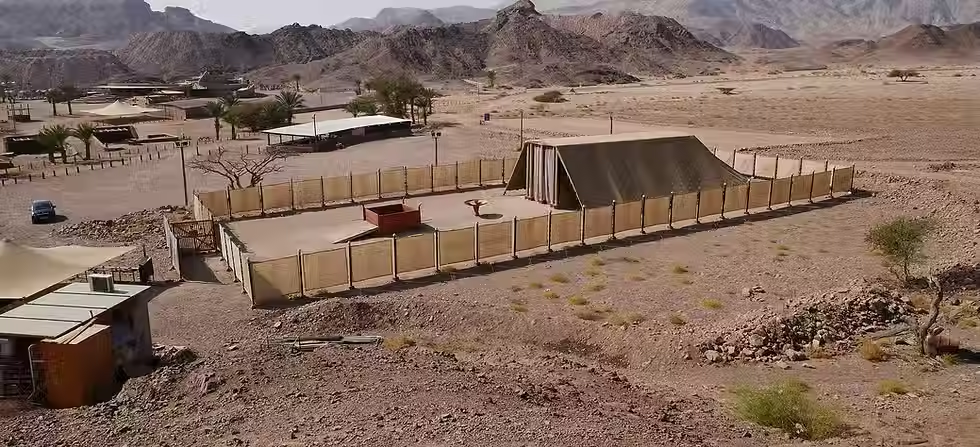
Due to the length of this study it has been broken up into three posts, or you can download a full PDF version:
In the previous section I asserted that the failure of the first generation of Israelites in the wilderness may find explanation in their multiple experiential traumas. In this section I would like to argue that God provided three solutions to bring healing and recovery for these traumas and that these solutions can be found in God’s presence, God’s Law and God’s Tabernacle.
Yahweh did not leave Israel without the means of healing from their traumas. In fact, this author would argue that the tabernacle and its furnishings were intended to point the nation to how to trust God instead of murmuring and complaining, but that they did not draw on this resource to grow and heal. Revisiting Janoff-Bulman’s earlier reference to how trauma shatters our assumptions about life one could make the case that God’s presence, God’s Law and the tabernacle speaks to each of her points:
The world is benevolent – The tabernacle structure and God’s presence over the mercy seat attended by the pillar of fire at night and the pillar of cloud during the day should have sent a clear message that the LORD God Almighty was present to protect and provide for them if they would only rest in Him. Repeatedly God stated His love for Israel (Deut. 4:7-8, 7:7, 10:15, 23:5), they simply refused to believe Him.
The world is meaningful – The presence of God rose off the tabernacle when it was God’s time for them to move on. They all knew that the goal was the Promised Land, and that God was leading them to that goal. Their lives had purpose and meaning!
The self is worthy – One of the most powerful images of God’s love for Israel was seen in the High Priests garments. The onyx stones on the shoulder pads were engraved with the names of the tribes of Israel, six on each stone. Beyond this, the ephod contained twelve gems one for each tribe of Israel, with their name engraved on it. When the High Priest went into the Holy Place and the Holy of Holies, he bore the people before God. Beyond this was the Altar of Incense where the prayers for the people ascended before God, day and night. They were worthy, for Yahweh made them worthy.
One thing we may overlook in the Exodus story is that by removing Israel from Egypt and leading them into a wilderness experience where they were confined to the closeness of their family units with no external threats to their safety, God may have provided a key element for effective trauma recovery. Dr. Bessel Van der Kolk observes that:
Traumatized human beings recover in the context of relationships: with families, loved ones, AA meetings, veterans’ organizations, religious communities, or professional therapists. The role of those relationships is to provide physical and emotional safety, including safety from feeling shamed, admonished, or judged and to bolster the courage to tolerate, face, and process the reality of what happened. [i]
God’s Presence
The fullest expression of “God with us” was reached in Exodus 40:34—38 when the tabernacle had been installed and Yahweh’s divine presence came down,
Then the cloud covered the tent of meeting, and the glory of the Lord filled the tabernacle. And Moses was not able to enter the tent of meeting because the cloud had settled on it, and the glory of the Lord filled the tabernacle. Throughout their journeys, whenever the cloud was taken up from over the tabernacle, the sons of Israel would set out; but if the cloud was not taken up, then they did not set out until the day when it was taken up. For throughout their journeys, the cloud of the Lord was on the tabernacle by day, and there was fire in it by night, in the sight of all the house of Israel.” (Italics added).
This was a truly a remarkable event in the ancient world, not only was Yahweh present and visible but He also personally led Israel from place-to-place. On a practical note, we should remember that throughout their time in the wilderness there were multiple times when Israel failed to trust God (Ex. 5:21; 14;11; 15:24; 16:2; 17:2-3; 32:1; Num. 11:1, 4; 12:1; 14:2), yet these experiences of being “tested” by God occurred in places to which He led them. John Walton speaks to this unique relationship of a god to a people group when he writes:
In the ancient Near East at large this service (to the god) was accomplished in terms of caring for the god through ritual and preserving order in society and the cosmos. In Israel it was accomplished by obeying the Torah, which showed them how to love the Lord their God with all their hearts and minds and strength and to reflect the holy status that God had given them by maintaining Torah order … No other culture in the ancient Near East understood themselves in such a relationship to the divine realm.[ii]
God’s Law
In our contemporary western worldview, we tend to view God’s Law as a restrictive and negative imposition, a violation of a peoples’ freedom. But what if it designed by God to provide a sense of freedom they had never experienced before? John Walton explains that
“In the ancient Near East it was the rare exception that anyone thought that they could identify with confidence the cause of a deity’s anger. Since there was no revealed code of conduct.” [iii]
If there is one thing that Torah Law did provide Israel with, it was clear guardrails for what would provide order and structure to their daily life and what would not. They did not have to try and guess which god they had offended or what the remedy was. The Law spelled out clearly God’s expectations and the consequences they would experience if they failed to obey. These laws were for their protection and blessing, not to restrict their freedom.
Case in point, immediately after the confirmation of the Covenant between Yahweh and the nation (Exo. 19:1-7) God lays down a number of laws related to their daily living (Exo. 20-22). These included what we commonly refer to as the Ten Commandments, plus several other regulations related to the treatment of slaves, violence against others, respect for private property, theft & restitution, liability issues and others. These “laws” would have served as “guardrails" on how a people should treat one another. God’s Law and its prohibitions well may have been key to the survival and expansion of the nation of Israel in an environment (wilderness wandering) that may have destroyed any other people group.
God’s Tabernacle
John Walton puts the tabernacle into the larger picture of God’s plan for the nation of Israel when he explains that:
Although Moses is the primary human character of the Exodus narratives, the real story is the redemptive work of Yahweh in delivering Israel from slavery in Egypt and establishing a unique covenant relationship with the nation. These acts of God signaled his good intentions to keep the promises made generations ago to Abraham and the other patriarchs (cf. 3:7-16). Israel’s exodus from Egypt is the redemption event of the Old Testament. Along with the Covenant ceremony at Sinai it constitutes the high-water mark of Old Testament salvation history.[iv]
They also point out that “The tabernacle structure was designed to symbolize the active presence of the Lord among the Hebrews.”[v]
This view of the tabernacle means that each furnishing and element in the tabernacle might be considered instrumental to God’s intention to bring healing and recovery to traumatized Israel.
Perhaps a couple of comments about my own personal work experience will help the reader to understand what I saw when reading the tabernacle descriptive text. Over a lifetime of work, my experience has been in two major fields: 1) creating technical manuals/documentation for the tech industry, and 2) the building trades. In the year 2020 I retired from a residential and commercial remodeling company in the greater Seattle area.
My experience in the construction industry served as a lens to what I read in Exodus 25-30 and 35-40. These extremely detailed instructions to Moses on the tabernacle and its furnishings read like a set of Construction Design Specifications for a building project. Attorneys Shipman and Wright, LLP say that such specifications … “describe in precise detail the materials to use and methods to employ when performing the work on a construction project, and the contractor must not deviate from the provided specifications.”[38] Based on this awareness I scheduled an interview with a local remodeling company owner who has several people on his staff who create Design Specifications and project designers in a construction project. [39] I expected to hear about the qualifications needed to be a successful Construction Designer, things such as creativity, professional training, technical expertise and knowledge of applicable building codes. Instead, his first comment was that the primary job requirement is skill in “listening and communication”. The ability to build a relationship with a client and truly hear what they are saying.” Of course, all the other skills are needed but the real key to creating a design that reflects the wants and needs of the client is to be able to really “hear” what they are saying and translate that into a functional plan and detailed specifications of materials, colors and textures that reflects their vision of the completed project. Applying this to the story of the Exodus we might think of Yahweh as the “client” and Moses’ job was to “hear” what God was trying to communicate to him. This understanding led to the thought that this structure and its creation might have grown out of the close relationship between God and Moses. A relationship of free and open communication between the two of them. Reviewing Moses’ encounters with Yahweh makes this seem more tenable. Moses first encountered “the angel of the LORD” at the burning bush (Exo. 3:2) where a conversation was initiated by the angel. In both chapters 3 and 4 of Exodus we find a running conversation between Moses and God with Moses trying to argue why he is not the right person to lead Israel from their slavery to Egypt and God countering every objection. Then there were regular conversations throughout the plagues on Egypt as God led Moses to confront Pharoah and the gods of Egypt. And finally, there is an interesting comment about the relationship between Moses and Yahweh in Exodus 33:7-11 where we read that:
Now Moses used to take the tent and pitch it outside the camp, a good distance from the camp, and he called it the tent of meeting. And everyone who sought the Lord would go out to the tent of meeting which was outside the camp … Whenever Moses entered the tent, the pillar of cloud would descend and stand at the entrance of the tent; and the Lord would speak with Moses … So the Lord used to speak to Moses face to face, just as a man speaks to his friend ... (emphasis added).
Mark Scarlata speaks to the unique relationship between Moses and Yahweh when he says, “Moses is the only person in the Old Testament who speaks to YHWH face to face, and we are made privy to these conversations.”[vi]
This relational communication dynamic appears to be in play when God calls Moses up to Mount Sinai to meet with Him and Moses then spends 40 days and 40 nights in God’s presence. (Exodus 25:40). Obviously, there was a lot of content regarding how Israel was to live (the Law) and the construction of the tabernacle, but 40 days and 40 nights is a long time to BE in God’s presence. Some level of comfort seems to be present in this encounter. Certainly, more than just getting “information” from Yahweh to pass on to Israel!
All of this carries the sense that Yahweh was not simply dictating His Law and the tabernacle plans to Moses, but that theirs was a deep personal relationship, and that the nation of Israel was clearly aware of the uniqueness of this relationship (see Exodus 34:29). It is this writers’ conviction that the Design Specifications for the tabernacle and its furnishings grew out of this unique “relationship” between Moses and Yahweh. That Moses possessed that ability to really “hear” what God desired in construction of the tabernacle.
Upon reading of Exodus 25-30 and 35-40 it became clear that the tabernacle and its furnishings would have required a lot of metals such as gold, silver and bronze, thousands of board feet of acacia wood, thousands of yards of fine linen fabric (or the mature flax plants needed to make the linen), an assortment of ram skins, goat skins as well as porpoise or badger skins, plus a variety of gemstones.
This begs the question “Where did they get all of these materials?” The answer can be found in a couple of passages. In Genesis 15 as God is making His covenant agreement with Abram, God tells him, “Know for certain that your descendants will be strangers in a land that is not theirs, where they will be enslaved and oppressed four hundred years. But I will also judge the nation whom they will serve; and afterward they will come out with many possessions.” (Gen. 15:13—14). The second part of the answer can be found in Exodus 12:35-36 that as Israel was fleeing Egypt, they “…had requested from the Egyptians articles of silver and articles of gold and clothing; and the LORD had given the people favor in the sight of the Egyptians, so that they let them have their request. Thus, they plundered the Egyptians.” What a sight it must have been. One can almost visualize the Israelites leaving Egypt with carts, wagons and pack animals carrying off tons of goods.
Words Matter
As a Design Specification document, the description of each item in the tabernacle is highly structured. Each item is introduced with the phrase “They shall construct” or “you shall make” (25:10, 25:23, 25:31, 26:1, 26:7; 26:15, 26:31, 27:1, 27:9, 28:1—39, 30:1—8). Following each of these initial directives are many additional statements of “Then you shall make…”, leaving the reader with a sense that this was intended to be read as a materials specification.
For this analysis thirty-six words stood out as describing materials to be used for constructing the tabernacle and its furnishings in Exodus 25—30 and were considered “key words.” The English word for each item was looked up in multiple Bible translations, searching for variations. Then the Hebrew for each was consulted to see if there was a lot of variation in the original language. These words included contribution, dwell, sanctuary, tabernacle, pattern, Acacia wood, ark, gold, silver, bronze, mercy seat, cherubim, table (of showbread), lampstand, curtains of fine twisted linen, covering of Goat skins, covering of ram skins dyed red, covering of fine leather above, boards, sockets, breast piece of judgement, ephod, robe, tunic of checkered work, turban, sash, purple, scarlet, blue, ruby, topaz, emerald, turquoise, sapphire, diamond, jacinth, agate, amethyst, beryl, onyx, jasper, Urim & Thummin, laver of bronze, anointing oil. A chart comparing these words side-by-side in four different translations can be found in Appendix A.
For the number of individual items in these chapters there is surprisingly little variation from translation to translation and most of these seem to be attributable to imprecise understanding of early Hebrew and/or the use of different words with similar meanings. For example, the NASB2020 version of Exodus 26:14 says, “And you shall make a covering for the tent of rams’ skins dyed red and a covering of fine leather above”. Strong’s Concordance defines the fine leather (H5785) from the Hebrew ʿôr which simply means “skin, hide” and can refer to any number of animals or even human skin. The NKJV uses the word “badger skins” (H8476), taḥaš meaning a kind of leather, skin or animal hide.[vii] These terms are almost interchangeable. The same seems to be the case where different gemstones are mentioned for the ephod that the priest wore. Some seem to be subsets of one another or a stone from the same family. This author’s conclusion is that these terms are stable, interchangeable and not a major concern for interpretation.
In the Design Specification sheets that follow, each furnishing includes a statement of materials to be used, measurements and some core “Observations and Spiritual Significance” of each item. It follows the order found in Exodus 25 – 30 and starts with the Ark / Mercy Seat and end with the Outer Court. The “Observations and Spiritual Significance” statements are from the perspective of being symbolic of some aspect of God’s nature or character.
A visual illustration of the tabernacle and each furnishing in our passage. Each Design Specification contains the passage detailing the construction and the later completion of the item along with a statement on how it would reflect the nature and character of God for the nation.

Tabernacle tent and furnishings credit: Taken from the ESV® Study Bible (The Holy Bible, English Standard Version®), © 2008 by Crossway, a publishing ministry of Good News Publishers. Used by permission. All rights reserved.
 | Ark of the Covenant & Mercy SeatSpecifications: Exodus 25:10-22 Completion: Exodus 37:1-9 Dimensions: 2 ½ cubits long x 1 ½ cubits high (3.75’ long X 2.25’ wide X 2.25’ high) Materials:
|
Observations and Spiritual Significance:
This great and holy God provides a place for forgiveness of the nation and a place where He speaks to and directs His people through Moses. |
This furnishing was symbolic of God’s holiness and presense. God said, “There I will meet with you; and from above the mercy seat, from between the cherubim which are upon the ark of the testimony, I will speak to you about all that I will give you in commandment for the sons of Israel.” (Exo. 25:22). This fact alone makes it the most holy furnishing in the entire tabernacle.
The website acaciawood.com points out that acacia wood is a sustainable product, that it is extremely durable, has a unique grain pattern and is commonly used to make furniture.[viii] This would make acacia the perfect choice for the manufacture of the major support structures and furnishings of the tabernacle. The use of acacia would reflect that God is available to all people and He is the source of strength to sustain life.
Gold overlay would likely be done as gold leaf applied to the acacia as there is no mention of nailing down thin sheets of gold. In the Bible as in culture in general gold symbolizes wealth, power and status. Israel’s God is superior over all others.
These two elements, acacia wood and gold were used for the many of the furnishings and major structural elements in the tabernacle.
Beyond everything else it is a fully man-portable furnishing. It was specifically designed so the God dwell with them in their travels. He was not a God locked in a building somewhere.
Specification for the Ark: “You shall make …”
an ark of acacia wood two and a half cubits long, one and a half cubits wide, and one and a half cubits high.
Overlay it with pure gold, inside and out
Make a gold molding around it.
cast four gold rings for it and fasten them on its our feet; two rings shall be on one side of it, and two rings on the other side of it.
poles of acacia wood and overlay them with gold.
put the poles into the rings on the sides of the ark, to carry the ark with them.
The poles shall remain in the rings of the ark; they shall not be removed from it.
put into the ark the testimony which I shall give you.
Specification for the Mercy Seat: “You shall make …”
Make two cherubim of gold; make them of hammered work at the two ends of the atoning cover.
make an atoning cover of pure gold, two and a half cubits long and one and a half cubits wide.
Make one cherub at one end and one cherub at the other end;
make the cherubim of one piece with the atoning cover at its two ends.
the cherubim shall have their wings spread upward, covering the atoning cover with their wings and facing one another
the faces of the cherubim are to be turned toward the atoning cover
put the atoning cover on top of the ark
in the ark you shall put the testimony which I will give to you.
I will meet with you … I will speak to you about every commandment that I will give you for the sons of Israel.”
 | Table of Showbread or Bread of the PresenceSpecifications: Exodus 25:23-30 Completion: Exodus 37:10-16 Dimensions: 2 cubits long x 1 cubit wide x 1 ½ cubits high (3’ long X 1.5’ wide X 2’.25’ high) Materials: Acacia wood with gold overlay and gold border |
Observations and Spiritual Significance:
This table was not designed for feeding the deity (god) but so the deity could “feed” His people as represented by the priests. Thus, it reminds the nation that God desires to live in relationship and fellowship with His people. |
In his book “A Commentary on the Book of Exodus” Umberto Casssuto points out that “The ‘bread of the Presence’ referred to in v. 30 was given to the priests to eat (Lev. Xxiv 5-9), and was kept on the table for a complete week in order that the priests who ministered to God should have the privilege of eating from God’s table.”[ix] As God’s representatives of the people they too participated in this special meal.
Specifications for the Table of Showbread/Bread of Presence: “You Shall Make …”
A table of acacia wood, two cubits (3 feet) long and one cubit wide (1.5 feet), and one and a half cubits (1.5 feet) high
Overlay it with pure gold and
A gold border around it
A rim of a hand width around it; and you shall make a gold border for the rim around it
Four gold rings for it and put rings on the four corners which are on its four legs. The rings shall be close to the rim, as holders for the poles to carry the table
Poles of acacia wood and overlay them with gold, so that with them the table may be carried
make its dishes, its pans, its jars, and its libation bowls with which to pour drink offerings; … of pure gold
Set the bread of the Presence on the table before Me continually.
 | Golden LampstandSpecifications: Exodus 25:31-39Completion: Exodus 37:17-34Dimensions: No specific dimensions.Materials: solid gold |
Observations and Spiritual Significance:
Many scholars believe that the Golden Lampstand not only pointed to Yahweh as the source of light/guidance for the nation but that being designed to mimic almond blossoms pointed to the original tree of life in the Garden of Eden, offering another avenue for restoration. |
The lampstand was among the most ornate pieces created for use in the tabernacle. The lampstand looked basically like a seven-branched menorah. It also resembled a tree with the cups at the end of each branch designed to mimic the appearance of almond blossoms with sculpted calyxes (outermost parts of a flower) and flowers (25:31–36). Many scholars believe that God commanded the floral design to remind the Israelites of the Tree of Life from the garden of Eden (Gen. 2:9). This is certainly an appropriate observation as true life is found only in God (Ps. 16:11), and this presence was made manifest in the tabernacle (Ex. 40:34–35). Almonds were also a symbol of hope and fruitfulness in the ancient Mediterranean world, so these ideas were also brought to mind when priests saw the lampstand.[x]
Specifications for the Golden Lampstand: “You shall make …”
A lampstand of pure gold
A base and its shaft … of hammered work
Its cups, its bulbs, and its flowers shall be of one piece with it
Six branches shall go out from its sides; three branches of the lampstand from its one side and three branches of the lampstand from its other side
Three cups shaped like almond blossoms on the one branch, a bulb and a flower, and three cups shaped like almond blossoms on the other branch, a bulb and a flower—the same for six branches going out from the lampstand
Four cups shaped like almond blossoms, its bulbs and its flowers
A bulb shall be under the first pair of branches coming out of it, and a bulb under the second pair of branches coming out of it, and a bulb under the third pair of branches coming out of it, for the six branches coming out of the lampstand
bulbs and their branches shall be of one piece with it; all of it shall be one piece of hammered work of pure gold
Lamps seven in number … to shed light on the space in front of it
Tongs and its trays shall be of pure gold … from a talent of pure gold, with all these utensils.
Follow the pattern for them, which was shown to you on the mountain
Specifications for the Table of Showbread/Bread of Presence: “You Shall Make …”
A table of acacia wood, two cubits (3 feet) long and one cubit wide (1.5 feet), and one and a half cubits (1.5 feet) high
Overlay it with pure gold and
A gold border around it
A rim of a hand width around it; and you shall make a gold border for the rim around it
Four gold rings for it and put rings on the four corners which are on its four legs. The rings shall be close to the rim, as holders for the poles to carry the table
Poles of acacia wood and overlay them with gold, so that with them the table may be carried
make its dishes, its pans, its jars, and its libation bowls with which to pour drink offerings; … of pure gold
Set the bread of the Presence on the table before Me continually.
 | Curtains of LinenSpecifications: Exodus 26:1-6 Completion: Exodus 36:8-13 Dimensions: 28 cubits long x 4 cubits wide (42’ long X 6’ wide) Materials: Fine twisted linen |
Observations and Spiritual Significance:
This innermost covering of the tent was woven from harvested flax plants. It was draped over the supporting side walls of the tabernacle and used the “royal” colors of violet, purple and scarlet. These curtains were joined by loops and clasps along their long edge so that they could be removed and folded as the tabernacle was moved from place to place.
Specifications for the Curtains of Linen: “You shall make …”
ten curtains of fine twisted linen and violet, purple, and scarlet material; you shall
make them with cherubim, the work of a skilled embroiderer
The length of each curtain shall be twenty-eight cubits (42 feet), and the width of each curtain four cubits (6 feet)
Five curtains shall be joined to one another, and the other five curtains shall be joined to one another
make loops of violet on the edge of the outermost curtain in the first set, and likewise you shall make them on the edge of the curtain that is outermost in the second set
make fifty loops in the one curtain, and you shall make fifty loops on the edge of the curtain that is in the second set; the loops shall be opposite each other
make fifty clasps of gold
join the curtains to one another with the clasps so that the tabernacle will be a unit
 | Curtains of Goat’s Hair, Rams Skin and Badger SkinsSpecifications: Exodus 26:7-14 Completion: Exodus 36:14-19 Dimensions: 30 cubits long x 4 cubits wide (45’ long X 6’ wide) Materials: Goats hair, ram skins, badger or porpoise skins |
Spiritual Significance & Observations:
These curtains speak to Yahweh’s protection and covering over the nation from the harshest effects of the wilderness. |
The remaining three curtains were in the words of Cassuto “served only as an outer protection against rain and wind and dust and the sun’s heat.”[xii] These too could be disassembled, folded and transported. One might say that in similar fashion.
Specifications for Curtains of Goat’s Hair, Ram’s Skins and Badger Skins: “You shall make…”
curtains of goats’ hair as a tent over the tabernacle; you shall make eleven curtains in all.
each curtain shall be thirty cubits (45 feet), and the width of each curtain four cubits (6 feet)
join five curtains by themselves and the other six curtains by themselves, and you shall double over the sixth curtain at the front of the tent.
fifty loops on the edge of the curtain that is outermost in the first set, and fifty loops on the edge of the curtain that is outermost in the second set.
fifty clasps of bronze … put the clasps into the loops and join the tent together so that it will be a unit.
The overhanging part that is left over in the curtains of the tent, the half curtain that is left over, shall hang over the back of the tabernacle.
The cubit on one side and the cubit on the other, of what is left over in the length of the curtains of the tent, shall hang over the sides of the tabernacle on one side and on the other, to cover it.
a covering for the tent of rams’ skins dyed red and a covering of fine leather above.
 | Boards & Bases for the Tabernacle [xiii]Specifications: Exodus 26:15-30 Completion: Exodus 36:20-34 Dimensions: Boards - 10 cubits x 1 ½ cubits (15” high X 2.25” wide) Materials:
|
Observations and Spiritual Significance:
The Acacia wood would have reflected Yahweh’s accessibility while the gold would speak to His power and status. |
This section explains the size and finish for the supporting walls of the tabernacle structure. These walls would provide adequate infrastructure for the four different curtains that were to be hung over them. Again, we encounter acacia wood with gold overlay. This gold overlay would symbolize wealth, power and status. Israel’s God is superior over all others.
With two gold walls, a woven screen on one end, a veil dividing the Holy Place from the Most Holy Place and a sky fabric covered with cherubim this must have been a dramatic environment.
Specifications for the Boards and Bases: “You shall make …”
the boards for the tabernacle of acacia wood, standing upright. Ten cubits (15 feet) shall be the length of each board and one and a half cubits (2.25 feet) the width of each board.
two tenons for each board, fitted to one another … twenty boards for the south side.
forty bases of silver under the twenty boards, two bases under one board for its two tenons and two bases under another board for its two tenons; and for the second side of the tabernacle, on the north side, twenty boards, and their forty bases of silver; two bases under one board and two bases under another board.
for the second side of the tabernacle, on the north side, twenty boards, and their forty bases of silver; two bases under one board and two bases under another board.
For the back of the tabernacle, to the west … six boards.
two boards for the corners of the tabernacle at the back. They shall be double beneath, and together they shall be complete to its top to the first ring
eight boards with their bases of silver, sixteen bases; two bases under one board and two bases under another board.
five bars of acacia wood, five for the boards of one side of the tabernacle,
five bars for the boards of the other side of the tabernacle
five bars for the boards of the side of the tabernacle for the back side to the west. The middle bar in the center of the boards shall pass through from end to end.
overlay the boards with gold
rings of gold as holders for the bars
overlay the bars with gold
erect the tabernacle according to its plan which you have been shown on the mountain.
 | Veil & ScreenSpecifications: Exodus 26:31-37 Completion: Exodus 36:35-38 Dimensions: Sizes are not specified but would have been calculated based on the presence of pre-built wall heights and widths. Materials:
|
Spiritual Significance and Observations:
The veil would have created a clear separation between sinful man and a holy God. God alone determines who can and cannot approach Him. |
The veil and screen are again of linen in the colors that signify the presence of royalty. Cassuto points out that due to space constraints the veil that separates the Holy Place from the Most Holy Place could not have been hung first as the pillars would not have left space for the ark of the covenant to pass through. Therefore the ark would have been in place first then the pillars and veil hung to cover and separate the space.[xiv]
This space was highly restricted. Evidently Moses was allowed to enter and engage in conversation with God almighty (Gen. 25:22). Besides Moses only the High Priest was allowed to enter and only once a year on Yom Kippur, the Day of Atonement. He was permitted to enter the enclosure to burn incense and sprinkle sacrificial animal blood. By this act the high priest atoned for his own sins and those of the priesthood.
In addition to the veil there was a second curtain called the “screen” that would separate the Holy Place from the courtyard where the animal sacrifices were performed.
Specifications for the Veil and Screen: “You shall make …”
a veil of violet, purple, and scarlet material, and fine twisted linen
with cherubim, the work of a skilled embroiderer.
hang it on four pillars of acacia overlaid with gold, their hooks also of gold, on four bases of silver.
hang up the veil under the clasps
bring in the ark of the testimony there within the veil; and the veil shall serve as a partition for you between the Holy Place and the Most Holy Place.
put the atoning cover on the ark of the testimony in the Most Holy Place
set the table outside the veil
the lampstand opposite the table on the side of the tabernacle toward the south; and you shall put the table on the north side.
a curtain for the doorway of the tent of violet, purple, and scarlet material and fine twisted linen, the work of a weaver.
five pillars of acacia for the curtain and overlay them with gold, their hooks also of gold; and you shall cast five bases of bronze for them.
 | The Bronze AltarSpecifications: Exodus 27:1-8 Completion: Exodus 37:1-7 Dimensions: 5 cubits square x 3 cubit high (7.5’ sq. x 4.5’ high) Materials:
|
Spiritual Significance & Observations:
Whenever an Israelite would pass through the curtained entrance into the outer courtyard the first thing seen would be the Bronze Altar. This is where the animal or grain sacrifice would be presented to the officiating priest for sacrifice. Cassuto once more points out that “…the altar was made hallow, consisting of an empty frame of wood overlaid with bronze, which could easily be filled from time to time with earth or stones … the fire was not kindled on the bronze … but upon the earth or the stones in the centre.”[xv] It also had a bronze grate midway down for placement of the sacrifice and four horns to which the animal could be tethered.
This altar made clear that humankinds first task in a relationship with God would be to humbly present an offering God has prescribed for forgiveness. |
Specifications for the Bronze Altar: “You shall make …”
the altar of acacia wood, five cubits long and five cubits wide; the altar shall be square, and its height shall be three cubits.
its horns on its four corners; its horns shall be of one piece with it, and you shall overlay it with bronze.
its pails for removing its ashes, and its shovels, its basins, its forks, and its firepans; you shall make all its utensils of bronze.
a grating, a netting of bronze, and on the netting you shall make four bronze rings at its four corners. And you shall put it under the ledge of the altar, so that the netting will reach halfway up the altar.
carrying poles for the altar, poles of acacia wood and overlay them with bronze
Its poles shall be inserted into the rings, so that the poles will be on the two sides of the altar when it is carried.
hollow with planks; as it was shown to you on the mountain, so they shall make it.
| Court of the TabernacleSpecifications: Exodus 27:9-21 Completion: Exodus 38:9-20 Dimensions: 100 cubits x 500 cubits (150” x 75”) Materials:
|
Spiritual Significance & Observations:
The court of the tabernacle was a walled enclosure. These walls were curtains of linen stretched between pillars of acacia wood with gold overlay, at equal spacing and a single gate at the east end of the courtyard. John Davis points out “It might be observed that the hangings around the outer court were exactly one half the height of the tabernacle itself which made the tabernacle plainly visible from outside the court.” [xvi]
The courtyard tells us that all may approach God, Jew and Gentile alike. Native Israeli and immigrants. None are excluded, but there is only one gate into God’s presence and forgiveness. God alone determines the means of approaching Him. |
Specifications for the Court of the Tabernacle: “You shall make …”
On the south side there shall be hangings for the courtyard of fine twisted linen, a hundred cubits (150 feet) long for one side
its pillars shall be twenty, with their twenty bases of bronze; the hooks of the pillars and their bands shall be of silver
for the north side in length there shall be hangings a hundred cubits long (150 feet), and its twenty pillars with their twenty bases of bronze; the hooks of the pillars and their bands shall be of silver
the width of the courtyard on the west side shall be hangings of fifty cubits (75 feet), with their ten pillars and their ten bases
The width of the courtyard on the east side shall be fifty cubits (75 feet).
The hangings for the one side of the gate shall be fifteen cubits (22.5 feet), with their three pillars and their three bases
for the other side there shall be hangings of fifteen cubits, with their three pillars and their three bases.
for the gate of the courtyard a curtain of twenty cubits, of violet, purple, and scarlet material and fine twisted linen, the work of a weaver, with their four pillars and their four bases.
the pillars around the courtyard shall be joined together with silver, with their hooks of silver and their bases of bronze.
The length of the courtyard shall be a hundred cubits (150 feet), and the width fifty throughout, and the height five cubits of fine twisted linen, and their bases of bronze.
the utensils of the tabernacle used in all its service, and all its pegs, and all the pegs of the courtyard, shall be of bronze.
 | Priestly GarmentsSpecifications: Exodus 28:1-43 Completion: Exodus: Exodus 39:1-31 Dimensions: Not applicableMaterials:
|
Additional Observations:
These garments place the nation of Israel front and center in God’s attention. These people, whom Yahweh delivered from bondage to Egypt were His top priority and, in His heart continually. |
The most complex element in the creation of the tabernacle is found in the explanation of the Priestly Garments. Complete detailing of these items is too complex for a paper such as this, so instead it will focus just on some of the elements of the Ephod and the gemstones in particular. This paper will not trace the history of each gemstone and its relationship to the specific tribes, but this topic would be one worthy of additional research. It is enough to say that each gemstone had the name of one of the twelve tribes engraved on it to represent each tribe of Israel so that as the High Priest entered into the very presence of Yahweh, he would “carry the names of the sons of Israel in the breastpiece of judgment/decision making over his heart when he entered the Holy Place, as a memorial before the Lord continually.”
Specifications for the Priestly Garments: “You shall make …”
holy garments for Aaron your brother, for glory and for beauty. These are the garments which they shall make:
a breastpiece,
an ephod,
a robe,
a tunic of checkered work,
a turban,
and a sash.
holy garments for your brother Aaron and his sons, so that he may serve as priest to Me. .
the ephod of gold, of violet, purple, and scarlet material, and fine twisted linen, the work of the skilled embroiderer.
It shall have two shoulder pieces joined to its two ends, so that it may be joined. The skillfully woven band of its overlay, which is on it, shall be like its workmanship, of the same material: of gold, of violet and purple and scarlet material and fine twisted linen.
take two onyx stones and engrave on them the names of the sons of Israel, six of their names on the one stone and the names of the remaining six on the other stone, according to their birth … set them in filigree settings of gold.
put the two stones on the shoulder pieces of the ephod, as stones of memorial for the sons of Israel, and Aaron shall carry their names before the Lord on his two shoulders as a memorial.
filigree settings of gold, and two chains of pure gold; you shall make them of twisted cord work, and you shall put the corded chains on the filigree settings.
a breastpiece of judgment … of gold, of violet, purple, and scarlet material, and fine twisted linen
square and folded double, a span in length and a span in width.
mount on it four rows of stones; the first row shall be a row of ruby, topaz, and emerald; and the second row a turquoise, a sapphire, and a diamond; 1 and the third row a jacinth, an agate, and an amethyst; 20 and the fourth row a beryl, and an onyx, and a jasper; they shall be set in gold filigree.
The stones shall be engraved according to the names of the sons of Israel: twelve, according to their names; they shall be like the engravings of a signet, each according to his name for the twelve tribes.
on the breastpiece twisted chains of cord work in pure gold.
on the breastpiece two rings of gold, and shall put the two rings on the two ends of the breastpiece.
put the two cords of gold on the two rings at the ends of the breastpiece.
put the other two ends of the two cords on the two filigree settings, and put them on the shoulder pieces of the ephod, at the front of it.
two rings of gold and place them on the two ends of the breastpiece, on the edge of it, which is toward the inner side of the ephod.
two rings of gold and put them on the bottom of the two shoulder pieces of the ephod, on the front of it close to the place where it is joined, above the skillfully woven band of the ephod. And they shall bind the breastpiece by its rings to the rings of the ephod with a violet cord, so that it will be on the skillfully woven band of the ephod, and that the breastpiece will not come loose from the ephod.
So Aaron shall carry the names of the sons of Israel in the breastpiece of judgment over his heart when he enters the Holy Place, as a memorial before the Lord continually.
put in the breastpiece of judgment the Urim and the Thummim, and they shall be over Aaron’s heart when he goes in before the Lord; and Aaron shall carry the judgment of the sons of Israel over his heart before the Lord continually.
make the robe of the ephod all of violet.
an opening at its top in the middle of it; around its opening there shall be a binding of woven work, like the opening of a coat of mail, so that it will not be torn.
on its hem pomegranates of violet, purple, and scarlet material all around on its hem, and bells of gold between them all around: a golden bell and a pomegranate, a golden bell and a pomegranate, all around on the hem of the robe.
It shall be on Aaron when he ministers; and its sound shall be heard when he enters and leaves the Holy Place before the Lord, so that he will not die.
You shall also make a plate of pure gold and engrave on it, like the engravings of a signet, ‘Holy to the Lord.’
fasten it on a violet cord, and it shall be on the turban; it shall be at the front of the turban. It shall be on Aaron’s forehead, and Aaron shall take away the guilt of the holy things which the sons of Israel consecrate, regarding all their holy gifts; and it shall always be on his forehead, so that they may be accepted before the Lord.
weave the tunic of checkered work of fine linen, and shall make a turban of fine linen, and you shall make a sash, the work of a weaver.
Aaron’s sons you shall also make tunics;
sashes for them,
caps for them, for glory and for beauty.
linen undergarments to cover their bare flesh;
they shall reach from the waist even to the thighs.
they shall be on Aaron and on his sons when they enter the tent of meeting, or when they approach the altar to minister in the Holy Place, so that they do not incur guilt and die.
 | Urum and ThumminSpecifications: Exodus 28:30 Completion: Not applicable Dimensions: None given Materials: Thought to be stones, but open to question. Additional Details: other passages that refer to them include Leviticus 8:8; Numbers 27:21; Hosea 4:12; Zechariah 10:2; Ezra 2:63; Nehemiah 7:65. |
Additional Observations:
Although we may not understand clearly what these were for or how they were used in the life of the nation of Israel, they do tell us that when God leads His people from slavery to freedom it often looks like wilderness and wandering. But even here He uses means that we simply don’t understand to confirm or deny our decisions and He can be trusted to lead us on a daily basis. |
The Urim and Thummin are somewhat shrouded in mystery. The Blue Letter Bible says that Urim (אוּרִים) means "lights" and were stones kept in a pouch on the high-priest’s breastplate, used in determining God’s decision in certain questions and issues.[xvii] And that Thummin (תֻּמִּים) means “perfection” and was a stone provided for the means of achieving a sacred lot. Used with the Urim to reveal God’s will.[xviii] These items are mentioned here and in Leviticus 8:8 and Numbers 27:21 and other passages.
The website Jewish Virtual Library adds that:
The Urim and Thummim (Heb. אוּרִים וְתֻמִּים) was a priestly device for obtaining oracles. On the high priest's ephod (an apron-like garment) lay a breastpiece (חֹשֶׁן) – a pouch inlaid with 12 precious stones engraved with the names of the 12 tribes of Israel – that held the Urim and Thummim (Ex. 28:15–30; Lev. 8:8). By means of the Urim, the priest inquired of YHWH on behalf of the ruler (Num. 27:21; cf. Yoma 7:5, "only for the king, the high court, or someone serving a need of the community"); they were one of the three legitimate means of obtaining oracles in early Israel (Urim, dreams, prophets; I Sam. 28:6).[xix]
Sakenfeld adds that additional research on the Old Testament makes it clear that even with extensive research over the decades by many different scholars these “are words of uncertain etymology” and that scholars differ on how exactly how they were used and what they looked like.[xx]

| Altar of IncenseSpecifications: Exodus 30:1-8 Completion: Exodus Dimensions: 1 cubit square by 1 ½ cubit high (18” square x 36” high) Materials:
|
The altar of incense would remind Israel to pray and be assured that their prayers were pleasing to Yahweh. |
Observations and Spiritual Significance:
The following quote is from Ligonier Ministries website and provides an insightful comment on this item.
Scripture often likens incense to the prayers of God’s people (Ps. 141:2; Rev. 5:8). This makes sense when we consider what happened on the altar of incense. Fine spices were mixed together and left to smolder on the altar day and night (Ex. 30:7–8, 34–38), the ascending smoke symbolizing that what was offered there went up to God, much as our prayers go up to Him. Being set outside the veil, the priest would see the smoke penetrate the curtain into the Holy of Holies even though He could not see past the curtain (v. 6). And is this not like prayer in that we know our prayers enter heaven itself even though we cannot yet see into that place?
Yet they were not inherently sweet, for atonement had to be made for the altar once a year (v. 10). John Calvin comments, “The altar of incense was purified by the sprinkling of blood, that they might learn that their prayers obtained acceptance through sacrifices.” [xxi]
Specifications for the Altar of Incense: “You shall make …”
an altar as a place for burning incense; you shall make it of acacia wood.
Its length shall be a cubit, and its width a cubit (18” sq.); it shall be square, and its height shall be two cubits; its horns shall be of one piece with it.
overlay it with pure gold, its top and its sides all around, and its horns;
make a gold molding all around it.
two gold rings for it under its molding; you shall make them on its two sides—on opposite sides—and they shall be holders for poles with which to carry it.
poles of acacia wood and overlay them with gold.
· put this altar in front of the veil that is near the ark of the testimony, in front of the atoning cover that is over the ark of the testimony, where I will meet with you.
burn fragrant incense on it … There shall be perpetual incense before the Lord throughout your generation
 | Laver of BronzeSpecifications: Exodus 30:17-21 Completion: Exodus 38:8 Dimensions: No dimensions given Materials: Bronze/brass |
The role of the Laver of Bronze was to serve as a place for the priests to wash both their hands and feet, prior to entering the tent of meeting. |
Additional Observations:
This particular item in God’s Design Specifications comes with few design requirements and a dire warning if it is not used by the priests. Strong’s Concordance lists the Hebrew word “basin” as H3595, כִּיּוֹר kîyôwr, kee-yore'; or כִּיֹּר kîyôr; from the same as H3564; properly, something round (as excavated or bored), i.e., a chafing-dish for coals or a caldron for cooking; hence (from similarity of form) a washbowl; also (for the same reason) a pulpit or platform: — hearth, laver, pan, scaffold. And as H5178 נְחֹשֶׁת nᵉchôsheth , nekh-o'-sheth; for H5154; copper, hence, something made of that metal.[xxii] It was used for ceremonial cleansing of the priest before entering the tabernacle structure itself.
Specifications for the Basin of Bronze: “You shall make …”
a basin of bronze, with its base of bronze, for washing; and you shall put it between the tent of meeting and the altar, and you shall put water in it.
Aaron and his sons shall wash their hands and their feet from it; when they enter the tent of meeting, they shall wash with water, so that they do not die; or when they approach the altar to minister, by offering up in smoke a fire sacrifice to the Lord.
So they shall wash their hands and their feet, so that they do not die; and it shall be a permanent statute for them, for Aaron and his descendants throughout their generations.
This examination of the materials used in the construction of the tabernacle shows us that each material and furnishing served as a visual aid of God’s holiness and His provision for forgiveness and healing.
God was truly “dwelling” with them. In addition to this the pillar of cloud by day and pillar of fire by night (Exodus 13:21-22; Nehemiah 9:12) should have been ample evidence of the reality of God’s presence.
In each Design Specification above you may have noted that there was a “Specification” heading and a “Completion” heading. It is important to mention at this juncture the event that takes place between the end of the specifications in chapter 30 and the narrative of the tabernacle being assembled beginning in chapter 35. Moses has now been up on the mountain top receiving input directly from Yahweh and the people become restless at his 40-day delay. In their distress they ask Aaron to make an idol that can lead them to return to Egypt. Aaron complies, gathers gold from the people and fashions a “molten calf” declaring “This is your god, O Israel, who brought you up from the land of Egypt.” (Exodus 32:4).
What follows is a scene of Yahweh’s anger that the nation could turn away so quickly from Him and a threat to simply be done with these “obstinate” people and destroy the nation. Chapters 32 and 33 detail the efforts of Moses to dissuade God from this plan and accompany them on the remainder of the journey.
We have seen that the nation of Israel had everything they needed to heal and recover from the traumas they experienced but most did not, and God allowed that first generation to perish in the wilderness. Dr. Paul Conti in his book shares a very interesting interview he had with Dr. Daryn Reicherter on the topic of worldview. Dr. Reicherter notes that “worldview matters because worldview is one of the factors that determine how people experience their trauma and how they go on to develop after it.” [xxiii] So too, our “worldview” of God and His presence can influence how successfully we process traumatic events.
As mentioned earlier Israel never truly abandoned their attachment to foreign idols either in the first generation or in succeeding generations. This writer would argue that their worldview of Yahweh and refusal to abandon idolatry was the root cause of their demise. Let’s turn now to the Christian Scriptures (New Testament) and get the Apostle Paul’s perspective on the cause of their failure.
Conclusions
Israel’s Experience
Understanding WHY Israel failed in the wilderness is important to followers of Christ today so that we will not follow in their same footsteps. Here we turn to the Apostle Paul and his observations regarding the Exodus narrative to gain insight. As a Jew trained in both Torah and tradition, he certainly is qualified to help us understand the exodus experience and how to not repeat Israel’s mistakes. In 1 Corinthians 10:1 – 14 he writes:
For I do not want you to be unaware, brothers and sisters, that our fathers were all under the cloud and they all passed through the sea; 2 and they all were baptized into Moses in the cloud and in the sea; 3 and they all ate the same spiritual food, 4 and all drank the same spiritual drink, for they were drinking from a spiritual rock which followed them; and the rock was Christ. 5 Nevertheless, with most of them God was not pleased; for their dead bodies were spread out in the wilderness.
6 Now these things happened as examples for us, so that we would not crave evil things as they indeed craved them. 7 Do not be idolaters, as some of them were; as it is written: “The people sat down to eat and to drink, and rose up to play.” 8 Nor are we to commit sexual immorality, as some of them did, and twenty-three thousand fell in one day. 9 Nor are we to put the Lord to the test, as some of them did, and were killed by the snakes. 10 Nor grumble, as some of them did, and were killed by the destroyer. 11 Now these things happened to them as an example, and they were written for our instruction, upon whom the ends of the ages have come. 12 Therefore let the one who thinks he stands watch out that he does not fall. 13 No temptation has overtaken you except something common to mankind; and God is faithful, so He will not allow you to be tempted beyond what you are able, but with the temptation will provide the way of escape also, so that you will be able to endure it.
14 Therefore, my beloved, flee from idolatry.
God’s Provision
In verses 1-4 Paul starts out by pointing out that every person who was a part of the exodus shared in a unique community exposure to God’s presence in the pillar of cloud and fire, in being delivered from the Egyptian army, in accepting God’s provision of manna daily and having their thirst quenched by water that God provided throughout their journey. These elements provided the entire community with a bond that they could draw upon in the hard times. But Paul also makes it clear that they never really came to trust this God who provided so abundantly for them.
Israel’s Response
Then in verses 6-10 he points out several areas in which they failed followed by the injunction to see them as an example of attitudes and actions to avoid. These included being idolators, sexual immorality, putting God to the test multiple times and just general grumbling about their life and circumstances.
The decisive statement in this section is found in verse 14 where he says “Therefore, my beloved, flee idolatry.” Here we are faced with the root of Israel’s failure, and we are back to what we talked about earlier that Israel NEVER abandoned their idols (Ezekiel 20:5-17). This was a clear violation of the very first commandment God issued to the nation,
I am the Lord your God, who brought you out of the land of Egypt, out of the house of slavery. You shall have no other gods before Me. You shall not make for yourself an idol, or any likeness of what is in heaven above or on the earth beneath, or in the water under the earth. You shall not worship them nor serve them; for I, the Lord your God, am a jealous God, (Exodus 20:1-5).
The old saying “The more things change, the more they stay the same” certainly applies to the topic of idolatry. The website dictionary.com defines idolatry as “the religious worship of idols, excessive or blind adoration, reverence, devotion, etc.” [xxiv] The very thing that followed Israel throughout their history continues to plague humankind today. The practice of giving anything or anyone else the attention and devotion that belongs only to our creator God. What kinds of things might be considered “idols” in our culture today?
|
|
Mind you, none of these items are bad in themselves, the issue we are addressing is that anything that occupies my thoughts, time and money may be considered an idol. It may not be bowing down to a wooden statue or image but simply has replaced my love for God and devotion to Him. Anything I count on to meet my deepest needs could be considered an idol as it takes the place of the creator God in my heart and mind.
Paul’s Own Experience
The Apostle Paul certainly experienced his own share of trauma in his life. He provides us with an interesting summary of his experiences in 2 Corinthians chapters 11 and 12:
Five times I received from the Jews thirty-nine lashes.
Three times I was beaten with rods,
Once I was stoned
Three times I was shipwrecked.
Spent a day and night in the sea
In dangers from rivers, robbers, own countrymen, Gentiles …
Sleepless nights, hunger, thirst
Daily concern for the health of the churches
A “thorn in the flesh to keep me from exalting myself.”
In chapter 12 verses 9-11 he tells us how he survived all of these without giving up: he recalls that God told him that “My grace is sufficient for you, for power is perfected in weakness.” Most of us simply hope that these stress producing experiences will simply pass, but Paul’s message seems to be that it is these very things that give us spiritual depth and maturity, and that this is the ultimate goal of a life that honors God. The book of James echoes this same message when he says “Consider it all joy, my brothers and sisters, when you encounter various trials, knowing that the testing of your faith produces endurance. And let endurance have its perfect result, so that you may be perfect and complete, lacking in nothing.” (James 1:2-4).
In pulling together the various strings of this study I believe there a several takeaways:
We all come out of our bondage to the ruler of this world (2 Corinthians 4:4) by God’s grace and power.
We all bring the baggage of our lives and experiences into our new relationship with God through His son Jesus.
We all face traumatic experiences in our lives but that as hurtful as they may be there is healing and recovery available through our relationship with God.
That God’s solutions for trauma include His presence, His guardrails for living (laws), and His provisions for daily living as revealed in the furnishings of the tabernacle.
It is my hope and prayer that these thoughts from the exodus experience bring you encouragement and help you to find healing and recovery through God’s presence, the community of faith and the services of a trained professional to move you on to become the person God intends.
Appendix A: Key words
A side-by-side comparison of words used in the specifications for the tabernacle structure in Exodus 25—28, 30 yields the following results. Highlights indicate words that differ from version to version.
NASB | NKJV | NRSV | NIV |
Contribution | Offering | Offering | Offering |
Dwell | Dwell | Dwell | Dwell |
Sanctuary | Sanctuary | Sanctuary | Sanctuary |
Tabernacle | Tabernacle | Tabernacle | Tabernacle |
Pattern | Pattern | Pattern | Pattern |
Acacia wood | Acacia wood | Acacia wood | Acacia wood |
Ark | Ark | Ark | Ark |
Pure gold | Gold | Gold | Gold |
Silver | Silver | Silver | Silver |
Bronze | Bronze | Bronze | Bronze |
Mercy seat | Mercy seat | Mercy seat | Mercy seat |
Cherubim | Cherubim | Cherubim | Cherubim |
Table (of showbread) | Table (of showbread) | Table (of Presence) | Table (bread of the presence) |
Lampstand | Lampstand | Lampstand | Lampstand |
Curtains of fine twisted linen | Curtains of fine twisted linen | Curtains of fine twisted linen | Curtains of fine twisted linen |
NASB2020 | NKJV | NRSV | NIV |
Covering of Goat skins | Covering of Goat skins | Curtains of goat hair | Curtains of goat hair |
Covering of ram skins dyed red | Covering of ram skins dyed red | Covering of tanned rams skins | Covering of ram skins dyed red |
Covering of fine leather above | Covering of badger skins | Outer cover of fine leather | Other durable leather |
Boards | Boards | Frames | Frames |
Sockets | Sockets | Bases | Bases |
Breastpiece of judgement | Breastpiece of judgement | Breastpiece of judgement | Breastpiece for making decisions |
Ephod | Ephod | Ephod | Ephod |
Robe | Robe | Robe | Robe |
Tunic of checkered work | Tunic of checkered work | Tunic of checkered work | Tunic of checkered work |
Turban | Turban | Turban | Turban |
Sash | sash | sash | sash |
Purple | Purple | Purple | Purple |
Scarlet | Scarlet | Scarlet | Scarlet |
Blue | Blue | Blue | Blue |
Onyx | Onyx | Onyx | Onyx |
Ruby | Sardius | Carnelian | Carnelian |
Topaz | Topaz | Chrysolite | Chrysolite |
Emerald | Emerald | Emerald | Beryl |
Turquoise | Turquoise | Turquoise | Turquoise |
Sapphire | Sapphire | Sapphire | Lapis lazuli |
Diamond | Diamond | Moonstone | Emerald |
Jacinth | Jacinth | Jacinth | Jacinth |
Agate | Agate | Agate | Agate |
Amethyst | Amethyst | Amethyst | Amethyst |
Beryl | Beryl | Beryl | Topaz |
Onyx | Onyx | Onyx | Onyx |
Jasper | Jasper | Jasper | Jasper |
Urim & Thummin | Urim & Thummin | Urim & Thummin | Urim & Thummin |
Laver of bronze | Laver of bronze | Bronze basin | Bronze basin |
Anointing oil | Anointing oil | Anointing oil | Anointing oil |
Altar of incense | Altar of incense | Altar of incense | Altar of incense |
Footnotes
[i] Bessel Van der Kolk. The body keeps the score: brain, mind, and body in the healing of trauma. 210.
[ii] John H. Walton. Ancient Near Eastern Thought and the Old Testament: Introducing the Conceptual World of the Hebrew Bible, Second Edition.119.
[iii] IBID, Walton, 107
[iv] Andrew E., Hill, and John H. Walton. 1991. A survey of the Old Testament. (Grand Rapids, Mich: Zondervan Pub. House). 103
[v] Hill and Walton. A survey of the Old Testament. 120.
[vi] Mark Scarlata, The abiding presence: a theological commentary on Exodus. SCM Press. 2018, 41.
[vii] "H5785 - ʿôr - Strong's Hebrew Lexicon (nasb20)." Blue Letter Bible. Web. 28 Apr, 2022. <https://www.blueletterbible.org/lexicon/h5785/nasb20/wlc/0-1/>.
[ix] Umberto Cassuto, A Commentary on the Book of Exodus. Jerusalem: Magnes, Hebrew U, 1983. Print, 337.
[xi] Messianic Revolution website, E26-3: What was the outermost covering of the Tabernacle's tent sanctuary really made out of? - WELCOME TO THE MESSIANIC REVOLUTION (messianic-revolution.com)
[xii] Umberto Cassuto, A Commentary on the Book of Exodus, 347.
[xiii] “The Tabernacle its construction and furnishings”, Part 19, http://sickleoftruth.com/Tabernacle/TABPAGE19.html
[xiv] Umberto Cassuto, A Commentary on the Book of Exodus, 360.
[xv] Umberto Cassuto, A Commentary on the Book of Exodus, 362.
[xvi] Davis, John J., Moses and the Gods of Egypt, Baker Book House, 1986. 273
[xvii] "H224 - 'ûrîm - Strong's Hebrew Lexicon (nasb95)." Blue Letter Bible. Web. 22 Apr, 2022. <https://www.blueletterbible.org/lexicon/h224/nasb95/wlc/0-1/>.
[xviii] "H8550 - tummîm - Strong's Hebrew Lexicon (nasb95)." Blue Letter Bible. Web. 22 Apr, 2022. <https://www.blueletterbible.org/lexicon/h8550/nasb95/wlc/0-1/>.
[xix] Jewish Virtual Library, Ancient Jewish History: The Urim and Thummin, https://www.jewishvirtuallibrary.org/the-urim-and-thummim
[xx] Katherine Doob Sakenfeld, GE., The New Interpreter’s Dictionary of the Bible, S-Z, Volume 5, 2000, Abington press, p. 719.
[xxi] The Altar of Incense, https://www.ligonier.org/learn/devotionals/altar-incense
[xxii] "H3595 - kîyôr - Strong's Hebrew Lexicon (nasb20)." Blue Letter Bible. Web. 28 Apr, 2022. <https://www.blueletterbible.org/lexicon/h3595/nasb20/wlc/0-1/>.
[xxiii] Conti, Paul (MD). (2021). Trauma: the invisible epidemic: how trauma works and how we can heal from it. Interview with Daryn Reicherter, MD, Clinical Professor of Psychiatry and current director of the Human Rights in Trauma Mental Health Laboratory at Stanford University. 85
Bibliography
Aharoni, Yohanan, and Karṭa. The Carta Bible Atlas. 4th Ed. with Index to Persons. ed. Jerusalem: Carta, 2002. Print.
Ancient Jewish History: The Ark of the Covenant, https://www.jewishvirtuallibrary.org/the-ark-of-the-convenant. Web.
Beale, G.K,. Kim, Mitchell. God dwells among us: expanding Eden to the ends of the earth. InterVarsity Press. 2014.
"BETWEEN TRADITION AND INNOVATION: JOSEPHUS'S DESCRIPTION OF THE TABERNACLE (ANT. 3.108-150) AS AN IMPROVED ALTERNATIVE TO THE GREEK BIBLE." Jewish Studies, an Internet Journal 19 (2020): 1-17. Web.https://jewish-faculty.biu.ac.il/files/jewish-faculty/shared/JSIJ19/castelli.pdf
Birnbaum, Aiton. (2008). Collective trauma and post-traumatic symptoms in the biblical narrative of ancient Israel. Mental Health, Religion & Culture. 11. 533-546. 10.1080/13674670701598565.
Blue Letter Bible. Web. 25 Apr, 2022. <https://www.blueletterbible.org/help/citation.cfm>.
Blue Letter Bible, "H4908 - miškān - Strong's Hebrew Lexicon (nasb95)." Blue Letter Bible. Web. 5 May, 2022. <https://www.blueletterbible.org/lexicon/h4908/nasb95/wlc/0-1/>.
Boase, Elizabeth, and Christopher G. Frechette. Bible Through the Lens of Trauma. Atlanta: SBL Press, 2016. Print.
Botterweck, G. Johannes, Ringgren, Helmer, and Fabry, Heinz-Josef. Theological Dictionary of the Old Testament. Grand Rapids, Mich.: Eerdmans, 1974. Print.
Brewin, Chris. Posttraumatic Stress Disorder: Malady or Myth? New Haven: Yale UP, 2003. Print. Current Perspectives in Psychology.
Budge. (1977). The dwellers on the Nile: the life, history, religion and literature of the ancient Egyptians (Dover edition.). Dover Publications, Inc.
Calvin, Jean, and Bingham, Charles William. Commentaries on the Four Last Books of Moses: Arranged in the Form of a Harmony, v. 2-3. Grand Rapids, Mich.: Eerdmans, 1950. Print. Calvin, Jean, 1509-1564. Commentaries. English.
Calvin, Jean, and Battles, Ford Lewis. Calvin: Institutes of the Christian Religion. Louisville, Ky.: Westminster John Knox, 2001. Print. Library of Christian Classics (Philadelphia, Pa.); v. 20-21.
Carasik, Michael, and Jewish Publication Society. The Commentators' Bible: The Rubin JPS Miqra'ot Gedolot = Miḳraʼot Gedolot. First ed. [2] Exodus Philadelphia: Jewish Publication Society, 2005. Print.
Cassuto, Umberto. A Commentary on the Book of Exodus. Jerusalem: Magnes, Hebrew U, 1983. Print.
Chelst, Kenneth, Exodus and emancipation: Biblical and African-American slavery (1st ed.). Urim Publications, 2009. Print.
Childs, Brevard S. The Book of Exodus: A Critical, Theological Commentary. Philadelphia: Westminster, 1974. Print. Old Testament Library.
Conti, Paul (MD). (2021). Trauma: the invisible epidemic: how trauma works and how we can heal from it.
Davis, John J., 1986), Moses and the gods of Egypt: studies in Exodus (2nd ed.). Baker Book House.
Dresner, Hannah. The Wilderness of Sinai. May 21, 2015https://www.myjewishlearning.com/2015/05/21/the-wilderness-of-sinai/. Web.
Epstein, Isidore. Hebrew-English Edition of the Babylonian Talmud. London: Soncino, 1965. Print.
Erman, Tirard, H. M., & White, J. M. (1971). Life in ancient Egypt (Tirard, Trans.). Dover Publications, Inc.
Freedman, H., and Simon, Maurice. Midrash Rabbah. 3rd ed. v. 3. Exodus / translated by S.M. Lehrman, London; New York: Soncino, 1983. Print.
Fretheim, Terence E., Exodus: Interpretation: A Bible Commentary for Teaching and Preaching, Presbyterian Publishing Corporation, 2010. ProQuest Ebook Central,
http://ebookcentral.proquest.com/lib/spu/detail.action?docID=5974210.
Holder, Arthur G., Bede, on the Tabernacle. Liverpool: Liverpool UP, 1994. Print. Translated Texts for Historians; v. 18.
Hooker, Ashley, Contributing Writer. What Is Generational Trauma and Is it in the Bible? Oct. 16, 2020. https://www.crosswalk.com/family/parenting/what-is-generational-trauma-and-is-it-in-the-bible.html
Jewish Virtual Library, Ancient Jewish History: The Urim and Thummin, https://www.jewishvirtuallibrary.org/the-urim-and-thummim
Johnston. (2004). Religions of the ancient world: a guide (Johnston, Ed.). The Belknap Press of Harvard University Press.
Joseph, Stephen. What Doesn't Kill Us the New Psychology of Posttraumatic Growth. New York: Basic, 2011. Web.
Kitchen, K. A., Ancient Orient and Old Testament, Inter-Varsity Press, Chicago, 1966
Koester, Craig R. The Dwelling of God: The Tabernacle in the Old Testament, Intertestamental Jewish Literature, and the New Testament. Washington, DC: Catholic Biblical Association of America, 1989. Print. Catholic Biblical Quarterly. Monograph Ser.; 22.
Lawrence, Paul, and Millard, A. R. The IVP Atlas of Bible History. Downers Grove, Ill.: IVP Academic, 2006. Print.
Leary, Joy DeGruy, and Robinson, Randall. Post Traumatic Slave Syndrome: America's Legacy of Enduring Injury and Healing. Newly Revised and Updated ed. Portland, Oregon]: Joy DeGruy Publications, 2017. Print.
Lienhard, Joseph T., Rombs, Ronnie J, and Oden, Thomas C. Exodus, Leviticus, Numbers, Deuteronomy. Downers Grove, Ill.: InterVarsity, 2001. Print.
Ligoneir Ministries, https://www.ligonier.org/l.
Luther, Martin, and Hilton, Oswald C. Lectures on the Minor Prophets. American ed. Saint Louis: Concordia, 1973. Print. Luther, Martin, 1483-1546. Works. English. American Edition. 1955; 18-20.
Matthews, & Benjamin, D. C. (1993). Social world of ancient Israel, 1250-587 BCE. Hendrickson Publishers.
Menakem. (2017). My grandmother’s hands: racialized trauma and the pathway to mending our hearts and bodies. Central Recovery Press.
Missler, Chuck, The Invisible War: Against the Gods of Egypt - Koinonia House Inc. https://www.khouse.org/articles/2000/263/
Page, Hugh R., Bailey, Randall C., Bridgeman, Valerie, Davis, Stacy, Murrell, Nathaniel Samuel, Kirk-Duggan, Cheryl, Masenya, Madipoane, and Sadler, Rodney Steven. The Africana Bible: Reading Israel's Scriptures from Africa and the African Diaspora. Minneapolis, Minnesota: Fortress, 2010. Print.
Ratzabi, Hila, What Was the Tabernacle (Mishkan)? A portable sanctuary in the wilderness, https://www.myjewishlearning.com/article/the-tabernacle/. Web.
Ringgren. (1973). Religions of the ancient Near East. Westminster Press.
Sakenfeld, Katherine Doob, and Abingdon Press. The New Interpreter's Dictionary of the Bible. Nashville, TN: Abingdon, 2006. Print.
Sarna. (1987). Exploring Exodus: the heritage of biblical Israel (1st Schocken pbk. ed.). Schocken Books.
Scarlata, Mark. The abiding presence: a theological commentary on Exodus. SCM Press. 2018
Silva, Moisés. New International Dictionary of New Testament Theology and Exegesis. Second Edition / Moisés Silva, Revision Editor. ed. Grand Rapids, Michigan: Zondervan, 2014. Print.
Simpson, A. B. Christ in the Tabernacle. New York: Word, Work and World, 1888. Print.
Strong, James. The Tabernacle of Israel in the Desert. Grand Rapids, Mich.: Baker Book House, 1952. Print.
Tabernacle illustrations from the ESV Study Bible, copyright (c) 2008 Crossway Bibles.
The New Interpreter's Bible. Volume I, General Articles on the Bible, General Articles on the Old Testament, the Book of Genesis, the Book of Exodus, the Book of Leviticus. Nashville: Abingdon, 1994. Print. New Interpreter's Bible.
Walton, John H. Ancient Near Eastern Thought and the Old Testament: Introducing the Conceptual World of the Hebrew Bible, Second Edition. Grand Rapids, Michigan: Baker Academic, 2006, 2018. Print.
What Was the Purpose and Meaning of the Tabernacle in Exodus? https://www.christianity.com/wiki/christian-terms/what-was-the-purpose-of-the-tabernacle.html

Comments