“GOD WITH US” Part 2: Exodus Through the Lens of Trauma
- Richard Lawrence
- Mar 23
- 32 min read

Updated: 7 days ago
Spiritual, Cultural & Psychological Influences
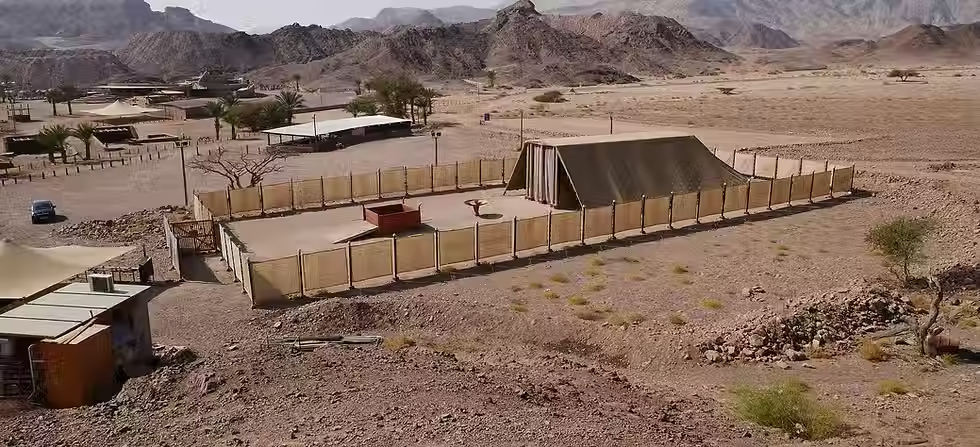
Due to the length of this study it has been broken up into three posts, or you can download a full PDF version:
"God With Us" Part 2: Exodus Through the Lens of Trauma
Spiritual, Cultural and Psychological Influences
All of us find that our lives are cluttered with many experiences in life that contribute to who we are and how we respond to the world around us. In like manner the exodus story is layered with many external influences that need to be understood to gain a clearer picture of the first generation of Israel and the possible reasons for their failure to live up to their commitment to Yahweh (Exo. 24:3). In this section I would like to touch on three such possible influences: Egyptian polytheism (Spiritual), political slavery and psychological stress (trauma).
Spiritual: Impact of Polytheism
In the ancient world there was no separation between the spiritual world and the natural world. Gods and goddesses were the ones who created all that exists, and they maintained order in the created world.[1] Everything we today would refer to as “natural laws” were anything but. Natural law did not exist in their manner of thinking. All aspects of life and nature were under the direct control of the gods and as the Encyclopedia Britannica points out “Egypt had one of the largest and most complex pantheons of gods of any civilization in the ancient world.”[2] Israel’s 400 plus years of being in bondage in Egypt would have exposed them daily to this belief system, especially since one of their primary tasks was the construction of Pharoah’s storage cities of Pithom and Raamses (Exo. 1:11). We know from archeological excavations that structures in Egypt were decorated with images of the Egyptian pantheon of gods. Add to this the fact that Judaism had not yet developed into a distinct faith yet but was more of a “family religion” in the way of thinking in the ancient world. This faith began with Abram’s encounter with the LORD in Genesis 12:1-3. In this regard John H. Walton observes that:
The Hebrew Bible makes clear that monotheism was not part of Abraham’s religious heritage. Abraham was of general Semitic stock, described in the Pentateuch as “Aramaean” (Gen. 25;20; 28:5; Deut. 26:5). Joshua 24:2 and 14 assert that the relatives of Abraham, including his father, served other gods, and the text of Genesis gives us no reason to question that assessment. Jacob has to urge his company to put away their other gods (Gen. 35:2-4), and teraphim, the images of the ancestral family gods are important in Laban’s religious practices (Gen. 31). It is clear then, that the biblical record does not attribute monotheism of any sort to the family of Abraham. In addition, we would search in vain for any passage in which Abraham or any of the patriarchs denies the existence. Nevertheless, the perspective of the biblical text is that all of the worship of Abraham that is recorded is focused on a single deity, though that deity is called by different names. The Bible, however, nowhere explicitly insists that this is the only God that Abraham ever worshipped. It can be safely inferred from the biblical data that Abraham showed a distinct preferential loyalty for a single god.[3]
Walton’s perspective is confirmed by words from the prophet Ezekiel when he recalls Israel’s history in the wilderness with the following words:
I am the Lord your God. 6 On that day I swore to them that I would bring them out of Egypt into a land I had searched out for them, a land flowing with milk and honey, the most beautiful of all lands. 7 And I said to them, “Each of you, get rid of the vile images you have set your eyes on, and do not defile yourselves with the idols of Egypt. I am the Lord your God.
8 But they rebelled against me and would not listen to me; they did not get rid of the vile images they had set their eyes on, nor did they forsake the idols of Egypt … 15 Also with uplifted hand I swore to them in the wilderness that I would not bring them into the land I had given them—a land flowing with milk and honey, the most beautiful of all lands— 16 because they rejected my laws and did not follow my decrees and desecrated my Sabbaths. For their hearts were devoted to their idols. 17 Yet I looked on them with pity and did not destroy them or put an end to them in the wilderness - Ezekiel 20:5-17 (emphasis added).
In spite of God’s command that “You shall have no other gods before Me” (Exo. 20:3) Israel never fully abandoned their practice of idolatry. In addition to the examples mentioned above we should remember that Israel’s first response when Moses delayed in coming down from Mt. Sinai was to ask Aaron to create a “golden calf” to lead them back to Egypt (Exo. 32:1-24). Idolatry was Israel’s “go to” response to difficulties.
Their exposure to the gods of Egypt would have had a tangible impact on the spiritual life of Israel. We refer to this practice as syncretism or hybridity and is defined as “… the result of adaptions and assimilation of either native or immigrant cultures or languages to the dominant culture or language.”[4]
This way of thinking about the ancient gods would have had a tangible impact on the spiritual life of Israel. They were exposed daily to gods and practices that were not consistent with what the God of Abraham, Issac and Jacob was or what He required of them. When Moses appeared on the scene and threw down challenges to Pharoah many theologians believe he was directly confronting the gods that the Egyptians worshipped and served. This view is expounded in an article on the Theology Schools website. The content and images that follow are from that material. [5]
The God of Israel is greater than all other Egyptian Gods and Goddesses.
Moses was called as God’s instrument to convince Pharaoh to allow the Israelites freedom from their bondage of slavery to the Egyptians. These “wonders” he performed are more commonly referred to as “plagues” sent from the God of Israel, as a proof that the “one true God” was far greater than all of the multiple Gods of the Egyptians.
These Egyptian Plagues were harsh and varied to correspond to the ancient Egyptian gods and goddesses that were prevalent during Moses’ time in Egypt.
 |
The first plague from God was that of turning the water to blood. As Aaron, the spokesperson for Moses, touched the “rod” of the Lord to the Nile River it immediately turned to blood, all the fish died, and the river stank. Partially able to duplicate this miracle, the magicians of Pharaoh also turn water into blood, leaving Pharaoh unimpressed with this great wonder from God.
Seven days the water throughout all the land of Egypt remained in this state, unsuitable for drinking, the perfect length of time to demonstrate that the Lord was superior to all the other Gods of Egypt.
 | #2: Heket - Egyptian Goddess of Fertility, Water, RenewalEgyptian Plague - Frogs coming from the Nile River |
The second plague that was visited upon Egypt, from the “rod” by Aaron, was that of frogs. The frogs came up from the river and were in their houses, in their food, in their clothing, in every place possible. From the greatest to the least, no one in Egypt escaped the plague of frogs. Pharaoh’s magicians were able to bring more frogs in their attempt to imitate the power of God, but only Moses was able to make the frogs go away.
 |
At the command of the Lord to Moses, Aaron was told to stretch forth his rod and smite the dust of the earth. When he did the dust became lice throughout all the land, on both people and beasts. The very dust that was referred to in the creation process of man is now used to plague men, as a reminder of his mortality and sin which both lead to death.
Finally, the magicians of Pharaoh are humiliated, being unable to compete with this power that was so much greater than themselves and the powers that they had from their Egyptian gods and goddesses, and they profess, “this is the finger of God.” This was the last plague that required Aaron’s involvement, as the next set of three plagues are issued by the word of Moses himself.
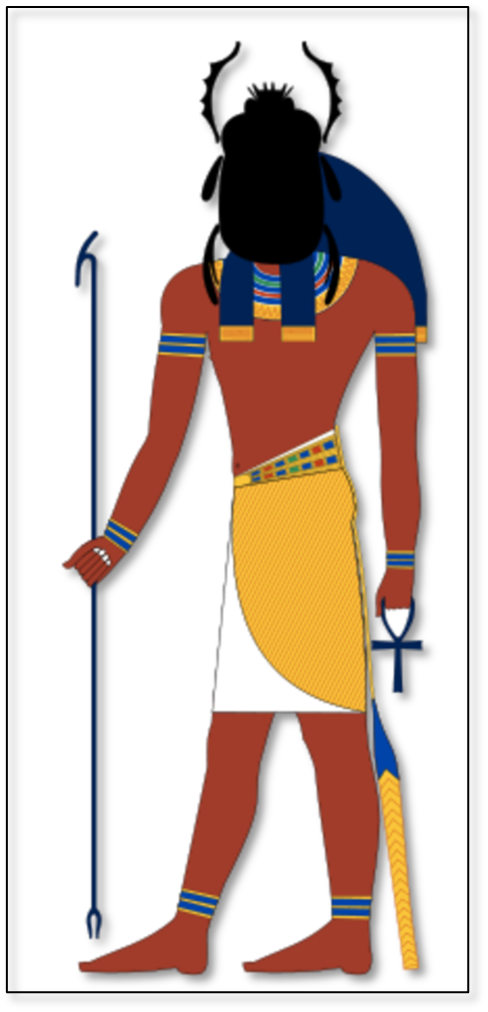 | #4: Khepri - Egyptian God of creation, movement of the Sun, rebirthEgyptian Plague - Swarms of Flies |
With the fourth Egyptian plague, which consisted of flies, begins the great miracle of separation. Moses met Pharaoh at the Nile River in the morning and made the demand, speaking on behalf of the Lord, “Let My people go, that they may serve Me.” Again, Pharaoh hardened his heart and disregarded the request, resulting in a pronouncement of swarms of flies.
This time, however, only the Egyptians are affected by the plague, and the children of Israel remain unscathed. This wonder also moves the Egyptian plagues to a different level, adding destruction as well as discomfort to the consequence of their decisions.
Plagued by flies, Pharaoh tried a new tactic and begins bargaining with the Lord, showing his desire to maintain power and authority over God. He tries to dictate the terms and conditions of the offer, telling them they may sacrifice but only “in the land” clearly not complying with the requested “three days journey” that the Lord required. Moses wouldn’t budge, and Pharaoh relented allowing them to leave, but telling them not to “go very far.
This temporary allowance is made solely to have Moses “intreat the Lord that the swarms of flies may depart.” At this point Pharaoh has learned in part who the Lord is and asks for His assistance over the Egyptian gods and goddesses. As soon as the request is granted by the Lord, Pharaoh reneges on his promise and will not let them go and continues to worship his Egyptian Gods.
 |
This plague was given with an advanced warning, allowing a period of repentance to occur, which goes unheeded.
“Tomorrow” the hand of the Lord would be felt upon all the cattle and livestock, of only the Egyptians, as ”grievous murrain.” This means that disease and pestilence would fall upon their livestock with so severe a consequence as to cause them to die. This plague affected the Egyptians by creating a huge economic disaster, in areas of food, transportation, military supplies, farming, and economic goods that were produced by these livestock. Still Pharaohs heart remained hard and he would not listen to the Lord but remained faithful to the Egyptian gods and goddesses.
 | #6: Isis - Egyptian Goddess of Medicine and PeaceEgyptian Plague - Ashes turned to Boils and Sores |
The sixth plague is unannounced and for the first time, directly attacking the Egyptian people themselves. Moses took ashes from the furnace of affliction and threw them into the air. As the dust from the ashes blew all over Egypt, it settled on man and beast alike in the form of boils and sores.
As with the previous two plagues a distinction is drawn between the Egyptians and the children of Israel, as God gives protection to his covenant people. The severity of the judgment of God has now become personal, as it is actually felt by the people themselves.
Cleanliness being paramount in the Egyptian society, this plague pronounces the people “unclean.” The magicians who have been seen throughout the previous plagues are unable to perform ceremonially rituals to their Egyptian Gods and Goddesses in this unclean state, not allowing them to even stand before Pharaoh; they are seen in the scriptural account no more. It is great to notice the contrast shown as Moses and Aaron are the only ones left standing in front of Pharaoh, with the “One True God” as their support.
 |
Pharaoh is warned of the impending doom that will be faced if he does not listen to the Lord, and forget his own Egyptian gods and goddesses.
Hail of unspeakable size and ability to destroy, would rain down from the sky and turn to fire as it hit the ground. The Lord, in showing Pharaoh that “there is none like Him in the Earth”, allows those who are willing to hear His word, and do as He commands, to be saved.
A division is now felt between the Egyptians in the form of those “converted” to the Lord, as shown by their obedience and willingness to escape to the protection of their “houses.”
Interestingly enough, the crops that were destroyed by the hail consisted of flax and barley, which were ripening in the fields. These two particular crops were not the mainstay of their diet but were used more specifically for their clothing and libations. This destruction would make their life uncomfortable, but as far as effecting their food supply , the wheat still survived. This gave the Egyptians still another chance to turn to “the One True God”, and forsake their own Egyptian gods and goddesses, thus showing His mercy and grace even yet.
 |
The eighth plague issued by the Lord had an even greater purpose than all the others, it was to be felt so that Pharaoh would tell even “his sons and son’s sons” the mighty things of the Lord, thus teaching even future generations of the power of the “strong hand of God” over all the other Egyptian gods and goddesses.
Moses and Aaron approached Pharaoh with the same request, “Let my people go so that they may serve me”, and pronounced the judgment of locusts if not heeded. This is the second wave of destruction to follow the hail, and whatever crops were left intact after that display, were now completely consumed by the swarms of locusts that were unleashed from the sky. This wonder definitely affected their life source. By hitting them in their food supply, the Lord displayed the possibility of eminent death if a change of heart did not occur. Yet still, Pharaoh would not listen.
 |
Darkness now fell upon Egypt, unannounced, as a prelude to the future fate to be felt by the Egyptian empire when the message of the Lord was not heeded, and they still turned to their own Egyptian gods and goddesses. Three days of palpable darkness, that was so immense it could be physically felt, covered the land of Egypt.
The sun, the most worshipped God in Egypt other than Pharaoh himself, gave no light. The Lord showed that he had control over the sun as a witness that the God of Israel had ultimate power over life and death. The psychological and religious impact would have been profound. Darkness was a representation of death, judgment and hopelessness. Darkness was a complete absence of light.
 |
Pharaoh, the king of Egypt, was worshipped by the Egyptians because he was considered to be the greatest Egyptian God of all. It was believed that he was actually the son of Ra himself, manifest in the flesh.
After the plague of darkness felt throughout the land was lifted, Pharaoh resumed his position of “bargaining with the Lord” and offered Moses another “deal.” Since virtually all of the Egyptian animals had been consumed by the judgments of the Lord, Pharaoh now consented to the request made, to let the people go, but they must leave their animals behind.
Enraged by the refusal, Pharaoh pronounced the last deadly plague to be unleashed upon the land from his very own lips as he warns Moses, “Get thee from me, take heed to thyself, see my face no more; for in that day thou seest my face thou shalt die.”
And Moses said, “Thus saith the Lord, About midnight will I go out into the midst of Egypt: And all the firstborn in the land of Egypt shall die, from the firstborn of Pharaoh that sitteth upon his throne, even unto the firstborn of the maidservant that is behind the mill; and all the firstborn of beasts. And there shall be a great cry throughout all the land of Egypt, such as there was none like it, nor shall be like it anymore.”

At this point the passive obedience that the children of Israel have shown is now moved to a level of active obedience. They are given strict instructions to follow so that they do not also feel the judgment of this last plague sent by the Lord. These instructions are known as “The Feast of Passover”, “The Feast of Unleavened Bread”, and “The Law of the Firstborn.” In these rituals are displayed the law of sacrifice, the law of the gospel, and the law of consecration, all necessary requirements to receive ultimate salvation from spiritual death.
These ten plagues would have upended the Egyptian religious system and proven that Yahweh alone is supreme and to be worshipped and served. These same Egyptian gods are ones that Israel was probably quite familiar with in their day-to-day lives as slaves in Egypt. The plagues must have sent shock waves through the land of Goshen, where Israel lived, as well. Based upon the thoughts of John H. Walton, earlier in this section, this writer would contend that Israel must have been impacted by the religious practices they were surrounded by.
Yahweh Himself makes it clear that these ten plagues were designed and executed as His judgment against the gods of Egypt. We are told in Exodus 12:12 that “I will go through the land of Egypt on that night, and fatally strike all the firstborn in the land of Egypt, from the human firstborn to animals; and against all the gods of Egypt I will execute judgments—I am the Lord. And again, in Numbers 33:4 we read that “while the Egyptians were burying all their firstborn whom the Lord had fatally struck among them. The Lord had also executed judgments against their gods.”
These passages make it clear that central to God’s confrontation with Pharoah was to show both Egypt and Israel that Yahweh alone is God and worthy of worship.
Impact of Slavery
No nation can come through over 400 years of political slavery, as did Israel and not be forever changed by the experience. This paper will not delve into a detailed analysis of Israel’s experience in Egypt but simply provide an overview of how the nations experience may have impacted them. Kenneth Chelst in his book Exodus and emancipation: Biblical and African-American slavery [6] compares these two historical events and uses them to enlarge our understanding of each event and of the reality of slavery in general. He notes that in Israel’s experience:
Joseph’s family arrived in Egypt as invited and honored guests of Pharoah. Joseph, who had started his sojourn in Egypt as a slave and became second only to Pharoah in authority, advised his brothers to use their occupational needs as an excuse for living apart from the mass of Egyptians… This privileged status lasted more than one hundred years, throughout the lives of the original arrivals. Within this setting, “They multiplied and increased very greatly so that the land was filled with them.” (Exodus 1:7) …. In any case, this new monarchy saw the Israelites’ size and power as a threat. Pharoah stirred a primordial fear that has been used against Jews and other minorities throughout history; that in the event of invasion, the Israelites would form a fifth column and side with the enemy.
Pharoah’s fear drives forward a narrative of threats against the birth of male babies as well as beatings and the general deprivation that Israel experienced under Egypt.
A person or nation that has never experienced forced slavey cannot truly understand the deep inroads that such an experience makes into the physical, emotional and mental health of an enslaved people. In her book Post Traumatic Slave Syndrome Dr. Joy DeGruy speaks to how Africans people brought to America as chattel slaves may have felt when she writes:
Perhaps of greatest impact, though, were the daily efforts of slave owners and others in authority to break the slaves will. Free will is at the core of being human. Can you imagine what it must be like to have your will assaulted on a daily basis? You live in a society that constantly reminds you that you are no different from livestock and in some cases less valuable. When you attempt to express yourself, you are beaten down. When you attempt to protect your loved ones, you are beaten down. You are beaten until you call the cruelest and most vile man you know, “Master.” And God forbid you attempt to be educated or think for yourself.” [7]
Certainly, the people of Israel understood this type of pain as well as we read in Exodus 1:12-15 that Pharoah and his taskmasters “afflicted them”, “compelled them”, “made their lives bitter with hard labor”, “rigorously imposed on them” and then hear the cry of the people for deliverance (Exodus 2:23). Another part of the impact of slavery is that of cultural displacement. The separation of the people from a “place” that has defined them and their family, perhaps for generations. The Africana Bible speaks to the importance of “place” in the Scriptures from the African perspective. One quote stands out: “For those experiencing a diaspora, a sense of both belonging and wholeness are often tied to particular sites:
communities, homes, sanctuaries for worship, and the like.”[8] In Exodus the nation of Israel is clearly living in a state of “diaspora” with no real sense of “place”, no settled place to call home and certainly not God’s promised land. This experience is true in our own day with so many people across the globe forced from their homes by famine, natural disasters and political violence and living in a state of diaspora. Knowing and trusting in God’s presence should have provided a level of stability that the environment did not.
Psychological Impacts
All of this raises the question: If God Himself was present with the nation of Israel in such a tangible manner as the pillar of cloud and pillar of fire in the midst of their camp, how do we explain their failure to trust Him in the wilderness? Part of the answer may lie in an understanding of how people react to stressful life events that we commonly refer to as “traumatic events.”
Israel had just been rescued by God from an oppressive slavery to Egypt for over 400 years. Their experiences in slavery included being beaten by Egyptian taskmasters, having the life of male babies threatened, the daily pressures and deprivation of slave existence, experiencing the plagues sent by God on Egypt, a sacrifice from each family to deter the “death angel”, a dramatic escape with the army of Egypt close behind, passing through the Red Sea, and arriving in a wilderness where there was no food or water. In today’s environment we would categorize any of those events as” traumatic”.
Psychologists point out some of the kinds of events that are known to produce trauma include military combat, natural disasters, terrorist threats, serious accidents, violent personal assault (physical, sexual, verbal), homelessness, witnessing a death, sudden death of a loved one, and long-term slavery. Any reading of the exodus event makes clear that the Israelites experienced all of these.
Looking back on the experience of Israel it is easy to criticize them for their grumbling against Moses, Aaron and God Himself as they experienced thirst, hunger and frustration at being in a wilderness instead of in the land God had promised their forefathers. As outside observers we see the tabernacle with the very presence of God hovering over it, leading the nation from one location to another and wonder why they could not accept and trust God’s leadership? In the book of Deuteronomy when Moses delivers his final address to the nation before his death, he reminds the nation of how much their God cared for them during their journey:
“Because He loved your fathers, therefore He chose their descendants after them. And He personally brought you from Egypt by His great power,” — Deut. 4:37
“The Lord did not set His love on you nor choose you because you were more in number than any of the peoples, for you were the fewest of all peoples, but because the Lord loved you and kept the oath which He swore to your forefathers, the Lord brought you out by a mighty hand and redeemed you from the house of slavery, from the hand of Pharaoh king of Egypt.”— Deut. 7:7-8
“Yet on your fathers did the Lord set His affection to love them, and He chose their descendants after them, even you above all peoples, as it is this day.” — Deut. 10:15
“Nevertheless, the Lord your God was not willing to listen to Balaam, but the Lord your God turned the curse into a blessing for you because the Lord your God loves you.” — Deut. 23:5
In these passages Moses highlights several ways God showed His concern and care such as “He loved your fathers”, “He personally brought you up”, His “affection” toward them and His “choice” of them. As we read of the tests that the nation faced in the wilderness and their rebellion against these tests, we should remember that all of it occurs within God’s great love and plan. Considering this, we should expect that the tabernacle and its furnishings would in some manner illustrate God’s love as well as His holiness.
How might this notion of “trauma” contribute to our understanding of the Exodus experience and the value of the tabernacle? My wife and I have volunteered for years with a ministry to homeless families with children in the greater Seattle, Washington area. This program has made us aware of the kinds of trauma that homeless people experience. The emotional highs and lows, the fears and anxieties faced are truly trauma inducing. The daily sense of fear and anxiety as a person faces their inability to control the situation and protect themselves or their children. One of the tools that social workers use in working with clients is called Trauma Informed Care (TIC). This approach provides a framework and counseling tools needed to help trauma victims with the healing process. I believe that much of Israel’s failure to trust God may find its explanation in the multiple traumas they had experienced.
The CDC (Centers for Disease Control) discusses trauma in a fact sheet that says,
“Most everyone has been through a stressful event in his or her life. When an event, or series of events, causes a lot of stress, it is called a traumatic event. Traumatic events are marked by a sense of horror, helplessness, serious injury, or the threat of serious injury or death.”
The factsheet continues,
“A person’s response to a traumatic event may vary. Responses include feelings of fear, grief and depression. Physical and behavioral responses include nausea, dizziness, and changes in appetite and sleep pattern as well as withdrawal from daily activities. Responses to trauma can last for weeks to months before people start to feel normal again.”[9]
But not all people return to their previous equilibrium quickly. We know even from the terrorist attack on the Twin Towers on 9/11 here in the United States or from PTSD experiences among military personnel, some never recover fully while others do. The chart on the following page from the CDC summarizes some of what the Israelites may have experienced:
Common Responses to a Traumatic Event [10]

Building off this chart, let’s just pick one “response” from each category above to see if we can find parallels in the experiences of the nation of Israel. Under Cognitive the response of “shortened attention span” is clear in that they grumbled over and over again whenever there was a lack of water, yet God had consistently provided for this need. Under Emotional a good example might be their sense of “being abandoned” by Yahweh and thus pleading to return to Egypt. Under the heading of Physical responses, we could point to their response of “fatigue” in that they tired of the manna God provided and begged for meat instead. And finally, under the heading of Behavioral we could point to their “change in sexual desire or functioning”. This is especially evident in the event of the Golden Calf and the orgy Israel held around that event as the Apostle Paul points out (1 Corinthians 10:8). The Exodus narrative is filled with experiences and commentary that points to a wide range of trauma inducing experiences, and their responses.
In our attempt to understand the purpose of the tabernacle in the wilderness this writer believes that the tabernacle itself in some way might have provided support for those who were traumatized. Lest you think that this approach to understanding of the Exodus story is just so much “whitewashing” or “blame-shifting”, over the past several decades many discoveries have been made in the fields of psychology, neuroscience and the human response to trauma. Obviously, I am not a trained psychologist or neurosurgeon but was surprised in my research at how well trauma might be understood as a mitigating factor in the life of Israel.
Trauma Hermeneutics
An entirely new field of Biblical study has emerged in recent decades called “Trauma Hermeneutics”. This approach to Biblical analysis looks at events in the Bible through the lens of trauma to better understand the underlying stressors of these events.[11] I believe that this view holds great promise for better understanding the Bible. This author believes that this lens of “trauma” is vital to understanding the failure of Israel in the wilderness.
A recent book titled Bible Through the Lens of Trauma is a collection of essays by various Christian writers exploring this concept in specific Bible passages. One comment from the introductory section of the book provides clarity:
Within the field of psychology, the study of trauma focuses on the range of responses evoked by an experience perceived to pose an extreme threat and that overwhelms an individual’s ordinary means of coping. The degree to which the person is conscious of the threat may vary. The experience may involve a single incident or an ongoing situation of captivity, disaster, or systemic oppression.”[12]
Trauma Shatters our Assumptions about Life
Ronnie Janoff-Bulman, professor emerita of psychology at the University of Massachusetts Amherst, has done extensive research and treatment in the field of trauma and has developed a valuable concept for understanding its effects. Her early research focused on the subject of victimization and trauma. In her book Shattered Assumptions: Toward a New Psychology of Trauma, she speaks of the basic assumptions people hold that are often shattered by the reality of traumatic experiences:
Most generally, at the core of our assumptive world are abstract beliefs about ourselves, the external world, and the relationship between the two. More specifically, and most simply, I propose that our three fundamental assumptions are:
The world is benevolent - In general people believe that the world is a good place.
The world is meaningful - We believe that events in our world are meaningful, that they "make sense."
The self is worthy - in general we perceive ourselves as good, capable and moral individuals [13]
The nation of Israel was just coming out of 400 plus years of political slavery during which the world was not benevolent, it was not meaningful, and they were not worthy. It is this author’s conviction that these experiences of life should be taken into consideration in any observations made about the first generation that came out of Egypt.
Neuroscience
A great deal of research has been done in the field of neuroscience trying to understand how trauma impacts human beings mentally, emotionally and physically. Bessel van der Kolk, MD has spent his professional life studying how children and adults adapt to traumatic experiences. He translates emerging findings from neuroscience and attachment research to develop and study a range of effective treatments for traumatic stress and developmental trauma in children and adults. In his book, The Body Keeps the Score: Brain, Mind, and Body in the Healing of Trauma he introduces this topic with the following comments:
… the birth of three new branches of science has led to the exploration of knowledge about the effects of psychological trauma, abuse and neglect. These new disciplines are neuroscience, the study of how the brain supports mental processes; developmental psychopathology, the study of the impact of adverse experiences on the development of mind and brain; and interpersonal neurobiology, the study of how our behavior influences the emotions, biology and mind-sets of those around us.
Research from these new disciplines has revealed that trauma produces actual physiological changes including a recalibration of the brains alarm system, and increase in stress hormone activity, and alterations in the system that filters relevant information from irrelevant. We now know that trauma compromises the brain area that communicates the physical, embodied feeling of being alive. These changes explain why traumatized individuals become hypervigilant to threat at the expense of spontaneity in engaging in their day-to-day lives. They also help us understand why traumatized people so often keep repeating the same problems and have such trouble learning from experience. We now know that their behaviors are not the result of moral failures or signs of lack of willpower or bad character – they are caused by actual changes in the brain. [14]
This book provides a better understanding of the importance of this field of study in both its scientific and practical implications. But there are other considerations in our thoughts about how trauma may have affected the nation of Israel.
Trauma is Intergenerational
In addition to the concept of trauma hermeneutics and the impact of trauma on the human mind and body, there is also a recent field of psychology called Post Traumatic Slave Syndrome pioneered by Dr. Joy DeGruy. She defines PTSS as
… a condition that exists as a consequence of multigenerational oppression of Africans and their descendants resulting from centuries of chattel slavery. A form of slavery which was predicated on the belief that African Americans were inherently/genetically inferior to whites. This was then followed by institutionalized racism which continues to perpetuate injury.” [15]
Although her work addresses African American slave populations specifically, many of the principles she shares apply generally to slave populations both historical and current.
There is not time in this paper to explore how this syndrome impacts an enslaved population for centuries after the event itself. Suffice to say the people of Israel were certainly traumatized by their enslavement and this would have exhibited itself in their day-to-day reactions to stress inducing situations. This consideration should overlay any study of the Tabernacle and God’s statement that He would “dwell” in their midst. This paper asserts that the three factors of God’s presence, God’s Law and the tabernacle may have served as God’s means for addressing their multiple traumas with healing and recovery. In modern terms these elements might be considered Trauma Informed Care.
Trauma Informed Care
The Center for Healthcare Strategies points out that: “Trauma-informed care shifts the focus from “What’s wrong with you?” to “What happened to you?” A trauma-informed approach to care acknowledges that health care organizations and care teams need to have a complete picture of a patient’s life situation — past and present — to provide effective health care services with a healing orientation. Adopting trauma-informed practices can potentially improve patient engagement, treatment adherence, and health outcomes, as well as provider and staff wellness. It can also help reduce avoidable care and excess costs for both the health care and social service sectors.”[16]
This same website includes a six-part approach to Trauma Informed Care that they believe healthcare providers should inculcate into their practices to support traumatized individuals. The graphic below summarizes their findings and practices followed by a section highlighting possible parallels in the Exodus narrative.

Safety: Throughout the organization, patients and staff feel physically and psychologically safe.
The Exodus narrative is filled with examples of how God provided for Israel’s safety. Consider how Yahweh shielded them from the most drastic plagues, including the death plague, how He shielded them from Pharoah’s army and destroyed that same army.
Trustworthiness & Transparency: Decisions are made with transparency and with the goal of building and maintaining trust.
We see this principle in action in Exodus 18:24-26 where we read “So Moses listened to his father-in-law and did everything that he had said. Moses chose able men out of all Israel and made them heads over the people, leaders of thousands, of hundreds, of fifties, and of tens. Then they judged the people at all times; they would bring the difficult matter to Moses, but they would judge every minor matter themselves.”
Peer Support: Individuals with shared experiences are integrated into the organization and viewed as integral to service delivery.
By redeeming Israel from Egyptian slavery and moving them into a “wilderness” the people were free from external human threats to their security. Within this environment of family and friends with a shared experience they could find mutual understanding and support.
Collaboration: Power differences – between staff and clients – are leveled to support shared decision making.
They had Moses, his selected co-leaders as well as a priestly organization who could support the nation’s need for justice and reconciliation on a day-to-day basis.
Empowerment: Patient and staff strengths are recognized, built on and validated – this includes a belief in resilience and the ability to heal from trauma.
In the Exodus story we find that God becomes so frustrated with the nation that He wants to simply end them and start over with Moses. But in the midst of this, Moses pleads with Yahweh to be patient with the nation (Exodus 32). Moses believed strongly in the nation’s ability to return to God and heal.
Humility & Responsiveness: Biases and stereotypes (e.g., based on race, ethnicity, sexual orientation, age, geography) and historical trauma are recognized and addressed.
After the nation “all responded with one voice: “Everything that the LORD has said we will do.” (Exo. 19:8) God gave them not only the Ten Commandments but also numerous additional instructions in Exodus 21-23 about how to treat their own slaves, guardrails on expressing violence against others, showing respect for animals and for other people, property rights, and even about not oppressing immigrants in their midst.
Although the Bible makes no specific claims to being a manual for mental health and healing it does provide examples of God providing for His people in such a way as to make healing and recovery possible.
In his book Exploring Exodus: The Heritage of Biblical Israel, Nahum M. Sarna speaks at length about the experience of the nation of Israel at the foot of Mount Sinai where the people encountered a personal and fear inducing interaction with God Almighty. He makes the point that this experience and the tabernacle are tightly woven together. He says that “Through its instrumentality (the Tabernacle), the experience with the Divine Presence that occurred at Sinai could be extended as a living reality.”[17] And he continues this thread later remarking that:
The national experience with God that occurred there would be sustained and nourished through the presence of the sanctuary in the midst of the camp of Israel. This close association between the Tabernacle and Sinai is expressed in a number of ways.
During the theophany, the mount was separated into three distinct zones of increasing degrees of holiness and restriction of access. At the foot of the mount stood the people, and there the altar was setup; in which the laity had access. Higher up on the mount was the second zone of holiness, to which only the priests and elders were admitted. Corresponding to this in the Tabernacle was the Holy place, which was restricted to the priesthood. The summit of the mountain constituted the third zone, which was exclusively reserved for Moses. Its counterpart in the Tabernacle was the Holy of Holies. Just as the Lord communicated with Moses on the mountaintop, so He does in the Holy of Holies, and in the same way that the cloud covered Mount Sinai after Moses had ascended, so the Tabernacle became enveloped in cloud on its completion, and the pillar of fire hovered over both Sinai and it.[18]
Collective Trauma
Before leaving this topic, one more element of trauma needs to be mentioned although I found myself a little hesitant at first to give too much credit to this perspective. After all, we are talking about somewhere between 600,000 and 2.4 million people. Certainly not all of them succumbed to the pressure of their traumas. Weren’t there some in that first generation, besides Caleb and Joshua, who processed these traumas and healed? While looking for answers to this question I encountered the topic of “mass trauma” or “collective trauma” which looks at how traumatic events can affect large numbers of people on multiple continents. A 2020 article from the Psychology Today website provides valuable insight:
Whereas the term “trauma” typically refers to the impact that a traumatic incident has on an individual or a few people, collective trauma refers to the impact of a traumatic experience that affects and involves entire groups of people, communities, or societies. Collective trauma is extraordinary in that not only can it bring distress and negative consequences to individuals but in that it can also change the entire fabric of a community (Erikson, 1976). In fact, collective trauma can impact relationships, alter policies and governmental processes, alter the way the society functions, and even change its social norms (Chang, 2017; Hirschberger, 2018; Saul, 2014). For example, after the terrorist attacks on the United States on September 11, 2001, the United States altered their transportation and travel policies and procedures to enhance security. Although this traumatic incident occurred 19 years ago, the societal changes in travel policy can still be seen today.
Collective trauma is a response that can follow a variety of traumatic experiences. Situations that may elicit a collective trauma response may include but are not limited to: wars, natural disasters, mass shootings, terrorism, pandemics, systematic and historical oppression, recessions, and famine or severe poverty (Aydin, 2017; Chang, 2017; Hirschberger, 2018; Saul, 2014). Traumatic experiences like the ones listed above can lead to an onset of physiological, psychological, relational, societal, and spiritual consequences as reality is turned upside down. Although the trauma is dealt with collectively, the experiences and individual responses can vary greatly which may lead to increased confusion about what collective trauma looks like.[19]
In our own day the COVID-19 pandemic that started in 2019 shut down businesses, offices, factories, schools and restaurants. It threw the entire world into “lockdown”. Although much recovery has occurred, we are still experiencing its impact in areas such as educational shortcomings, manufacturing and delivery services still struggling to recover, political divisions and others. I think it behooves us to extend the same courtesy to the ancient Israelites in terms of withholding judgment that we expect others to extend to us in our recovery journeys.
Footnotes
[1] John H. Walton, Ancient Near Eastern Thought and the Old Testament, 154ff.
[3] John H. Walton. Ancient Near Eastern Thought and the Old Testament: Introducing the Conceptual World of the Hebrew Bible, Second Edition.112-113.
[4] Johnston. (2004). Religions of the ancient world: a guide, What is Ancient Mediterranean Religion?, Fritz Graf. The Belknap Press of Harvard University Press. 10.
[5] ONE GOD sends TEN Plagues For TEN Egyptian gods and goddesses, Theology School, January 13, 2021, https://theologyschool.org/2021/01/13/one-god-sends-ten-plagues-for-ten-egyptian-gods-and-goddesses/
[6] Chelst, Kenneth, Exodus and emancipation: Biblical and African-American slavery (1st ed.). Urim Publications. 51.
[7] Joy DeGruy, PhD, Post Traumatic Slave Syndrome: America's Legacy of Enduring Injury and Healing. Newly Revised and Updated ed. Portland, Oregon]: Joy DeGruy Publications, 2017. Print.
[8] Hugh R. Page, Randall C. Bailey, Valerie Bridgeman, Stacy Davis, Nathaniel Samuel Murrell, Cheryl Kirk-Duggan, Madipoane Masenya, and Rodney Steven Sadler. The Africana Bible: Reading Israel's Scriptures from Africa and the African Diaspora. Minneapolis, Minnesota: Fortress, 2010. Print. 66.
[9] Helping Patients Cope with a Traumatic Event, https://www.cdc.gov/masstrauma/factsheets/public/coping.pdf
10 Helping Patients Cope with a Traumatic Event
[11] Elisabeth Boase, and Christopher G. Frechette. Bible Through the Lens of Trauma.
[12] Elizabeth Boase, and Christopher G. Frechette. Bible through the Lens of Trauma. Atlanta, Georgia: SBL, 2016. Semeia Studies; Number 86. Web. 4.
[13] Ronnie Janoff-Bulman, Shattered Assumptions: Toward a New Psychology of Trauma. 6, 8, 11.
[14] Bessel Van der Kolk. The body keeps the score: brain, mind, and body in the healing of trauma. Viking. 2014. 2-3
[15] Dr. Joy Angela DeGruy, Post Traumatic Slave Syndrome,
[16] What is Trauma-Informed Care? - Trauma-Informed Care Implementation Resource Center (chcs.org). Wesite.
[17] Nahum M. Sarna. Exploring Exodus: the Heritage of Biblical Israel. 190-203.
[18] Nahum M. Sarna. Exploring Exodus: the Heritage of Biblical Israel. 190-191.
[19] https://www.psychologytoday.com/us/blog/lifting-the-veil-trauma/202005/what-is-collective-trauma
Bibliography
Aharoni, Yohanan, and Karṭa. The Carta Bible Atlas. 4th Ed. with Index to Persons. ed. Jerusalem: Carta, 2002. Print.
Ancient Jewish History: The Ark of the Covenant, https://www.jewishvirtuallibrary.org/the-ark-of-the-convenant. Web.
Beale, G.K,. Kim, Mitchell. God dwells among us: expanding Eden to the ends of the earth. InterVarsity Press. 2014.
"BETWEEN TRADITION AND INNOVATION: JOSEPHUS'S DESCRIPTION OF THE TABERNACLE (ANT. 3.108-150) AS AN IMPROVED ALTERNATIVE TO THE GREEK BIBLE." Jewish Studies, an Internet Journal 19 (2020): 1-17. Web.https://jewish-faculty.biu.ac.il/files/jewish-faculty/shared/JSIJ19/castelli.pdf
Birnbaum, Aiton. (2008). Collective trauma and post-traumatic symptoms in the biblical narrative of ancient Israel. Mental Health, Religion & Culture. 11. 533-546. 10.1080/13674670701598565.
Blue Letter Bible. Web. 25 Apr, 2022. <https://www.blueletterbible.org/help/citation.cfm>.
Blue Letter Bible, "H4908 - miškān - Strong's Hebrew Lexicon (nasb95)." Blue Letter Bible. Web. 5 May, 2022. <https://www.blueletterbible.org/lexicon/h4908/nasb95/wlc/0-1/>.
Boase, Elizabeth, and Christopher G. Frechette. Bible Through the Lens of Trauma. Atlanta: SBL Press, 2016. Print.
Botterweck, G. Johannes, Ringgren, Helmer, and Fabry, Heinz-Josef. Theological Dictionary of the Old Testament. Grand Rapids, Mich.: Eerdmans, 1974. Print.
Brewin, Chris. Posttraumatic Stress Disorder: Malady or Myth? New Haven: Yale UP, 2003. Print. Current Perspectives in Psychology.
Budge. (1977). The dwellers on the Nile: the life, history, religion and literature of the ancient Egyptians (Dover edition.). Dover Publications, Inc.
Calvin, Jean, and Bingham, Charles William. Commentaries on the Four Last Books of Moses: Arranged in the Form of a Harmony, v. 2-3. Grand Rapids, Mich.: Eerdmans, 1950. Print. Calvin, Jean, 1509-1564. Commentaries. English.
Calvin, Jean, and Battles, Ford Lewis. Calvin: Institutes of the Christian Religion. Louisville, Ky.: Westminster John Knox, 2001. Print. Library of Christian Classics (Philadelphia, Pa.); v. 20-21.
Carasik, Michael, and Jewish Publication Society. The Commentators' Bible: The Rubin JPS Miqra'ot Gedolot = Miḳraʼot Gedolot. First ed. [2] Exodus Philadelphia: Jewish Publication Society, 2005. Print.
Cassuto, Umberto. A Commentary on the Book of Exodus. Jerusalem: Magnes, Hebrew U, 1983. Print.
Chelst, Kenneth, Exodus and emancipation: Biblical and African-American slavery (1st ed.). Urim Publications, 2009. Print.
Childs, Brevard S. The Book of Exodus: A Critical, Theological Commentary. Philadelphia: Westminster, 1974. Print. Old Testament Library.
Conti, Paul (MD). (2021). Trauma: the invisible epidemic: how trauma works and how we can heal from it.
Davis, John J., 1986), Moses and the gods of Egypt: studies in Exodus (2nd ed.). Baker Book House.
Dresner, Hannah. The Wilderness of Sinai. May 21, 2015https://www.myjewishlearning.com/2015/05/21/the-wilderness-of-sinai/. Web.
Epstein, Isidore. Hebrew-English Edition of the Babylonian Talmud. London: Soncino, 1965. Print.
Erman, Tirard, H. M., & White, J. M. (1971). Life in ancient Egypt (Tirard, Trans.). Dover Publications, Inc.
Freedman, H., and Simon, Maurice. Midrash Rabbah. 3rd ed. v. 3. Exodus / translated by S.M. Lehrman, London; New York: Soncino, 1983. Print.
Fretheim, Terence E., Exodus: Interpretation: A Bible Commentary for Teaching and Preaching, Presbyterian Publishing Corporation, 2010. ProQuest Ebook Central,
http://ebookcentral.proquest.com/lib/spu/detail.action?docID=5974210.
Holder, Arthur G., Bede, on the Tabernacle. Liverpool: Liverpool UP, 1994. Print. Translated Texts for Historians; v. 18.
Hooker, Ashley, Contributing Writer. What Is Generational Trauma and Is it in the Bible? Oct. 16, 2020. https://www.crosswalk.com/family/parenting/what-is-generational-trauma-and-is-it-in-the-bible.html
Jewish Virtual Library, Ancient Jewish History: The Urim and Thummin, https://www.jewishvirtuallibrary.org/the-urim-and-thummim
Johnston. (2004). Religions of the ancient world: a guide (Johnston, Ed.). The Belknap Press of Harvard University Press.
Joseph, Stephen. What Doesn't Kill Us the New Psychology of Posttraumatic Growth. New York: Basic, 2011. Web.
Kitchen, K. A., Ancient Orient and Old Testament, Inter-Varsity Press, Chicago, 1966
Koester, Craig R. The Dwelling of God: The Tabernacle in the Old Testament, Intertestamental Jewish Literature, and the New Testament. Washington, DC: Catholic Biblical Association of America, 1989. Print. Catholic Biblical Quarterly. Monograph Ser.; 22.
Lawrence, Paul, and Millard, A. R. The IVP Atlas of Bible History. Downers Grove, Ill.: IVP Academic, 2006. Print.
Leary, Joy DeGruy, and Robinson, Randall. Post Traumatic Slave Syndrome: America's Legacy of Enduring Injury and Healing. Newly Revised and Updated ed. Portland, Oregon]: Joy DeGruy Publications, 2017. Print.
Lienhard, Joseph T., Rombs, Ronnie J, and Oden, Thomas C. Exodus, Leviticus, Numbers, Deuteronomy. Downers Grove, Ill.: InterVarsity, 2001. Print.
Ligoneir Ministries, https://www.ligonier.org/l.
Luther, Martin, and Hilton, Oswald C. Lectures on the Minor Prophets. American ed. Saint Louis: Concordia, 1973. Print. Luther, Martin, 1483-1546. Works. English. American Edition. 1955; 18-20.
Matthews, & Benjamin, D. C. (1993). Social world of ancient Israel, 1250-587 BCE. Hendrickson Publishers.
Menakem. (2017). My grandmother’s hands: racialized trauma and the pathway to mending our hearts and bodies. Central Recovery Press.
Missler, Chuck, The Invisible War: Against the Gods of Egypt - Koinonia House Inc. https://www.khouse.org/articles/2000/263/
Page, Hugh R., Bailey, Randall C., Bridgeman, Valerie, Davis, Stacy, Murrell, Nathaniel Samuel, Kirk-Duggan, Cheryl, Masenya, Madipoane, and Sadler, Rodney Steven. The Africana Bible: Reading Israel's Scriptures from Africa and the African Diaspora. Minneapolis, Minnesota: Fortress, 2010. Print.
Ratzabi, Hila, What Was the Tabernacle (Mishkan)? A portable sanctuary in the wilderness, https://www.myjewishlearning.com/article/the-tabernacle/. Web.
Ringgren. (1973). Religions of the ancient Near East. Westminster Press.
Sakenfeld, Katherine Doob, and Abingdon Press. The New Interpreter's Dictionary of the Bible. Nashville, TN: Abingdon, 2006. Print.
Sarna. (1987). Exploring Exodus: the heritage of biblical Israel (1st Schocken pbk. ed.). Schocken Books.
Scarlata, Mark. The abiding presence: a theological commentary on Exodus. SCM Press. 2018
Silva, Moisés. New International Dictionary of New Testament Theology and Exegesis. Second Edition / Moisés Silva, Revision Editor. ed. Grand Rapids, Michigan: Zondervan, 2014. Print.
Simpson, A. B. Christ in the Tabernacle. New York: Word, Work and World, 1888. Print.
Strong, James. The Tabernacle of Israel in the Desert. Grand Rapids, Mich.: Baker Book House, 1952. Print.
Tabernacle illustrations from the ESV Study Bible, copyright (c) 2008 Crossway Bibles.
The New Interpreter's Bible. Volume I, General Articles on the Bible, General Articles on the Old Testament, the Book of Genesis, the Book of Exodus, the Book of Leviticus. Nashville: Abingdon, 1994. Print. New Interpreter's Bible.
Walton, John H. Ancient Near Eastern Thought and the Old Testament: Introducing the Conceptual World of the Hebrew Bible, Second Edition. Grand Rapids, Michigan: Baker Academic, 2006, 2018. Print.
What Was the Purpose and Meaning of the Tabernacle in Exodus? https://www.christianity.com/wiki/christian-terms/what-was-the-purpose-of-the-tabernacle.html
Comments